How to Choose an Online Broker: A 2026 Guide

Choosing the right online broker means matching the broker's protections and offerings to your trading needs and local regulatory environment. The key criteria: regulation and investor protection, fee transparency, trading platforms and tools, available markets, account types, and support quality. This guide walks through each decision step and shows how structured comparison data helps you evaluate options against a consistent framework rather than marketing claims.
Over 60% of new online traders prioritize regulatory compliance above all other factors when selecting a broker, citing security concerns. The decision to switch brokers, or to select one for the first time, should begin with your own profile: the assets you want to trade, your trading frequency, your risk tolerance, and your budget for deposits and fees. From there, verification of regulation and a transparent fee comparison form the foundation. Then you assess platforms, available instruments, and support quality.
Conditional alternatives and table
Start by identifying your core constraint. Are you replacing a broker because its platform lacks a feature you need? Because fees on your preferred instrument are too high? Because you need a specific account type, Islamic, joint, corporate? Because your current broker's regulation offers insufficient investor protection?
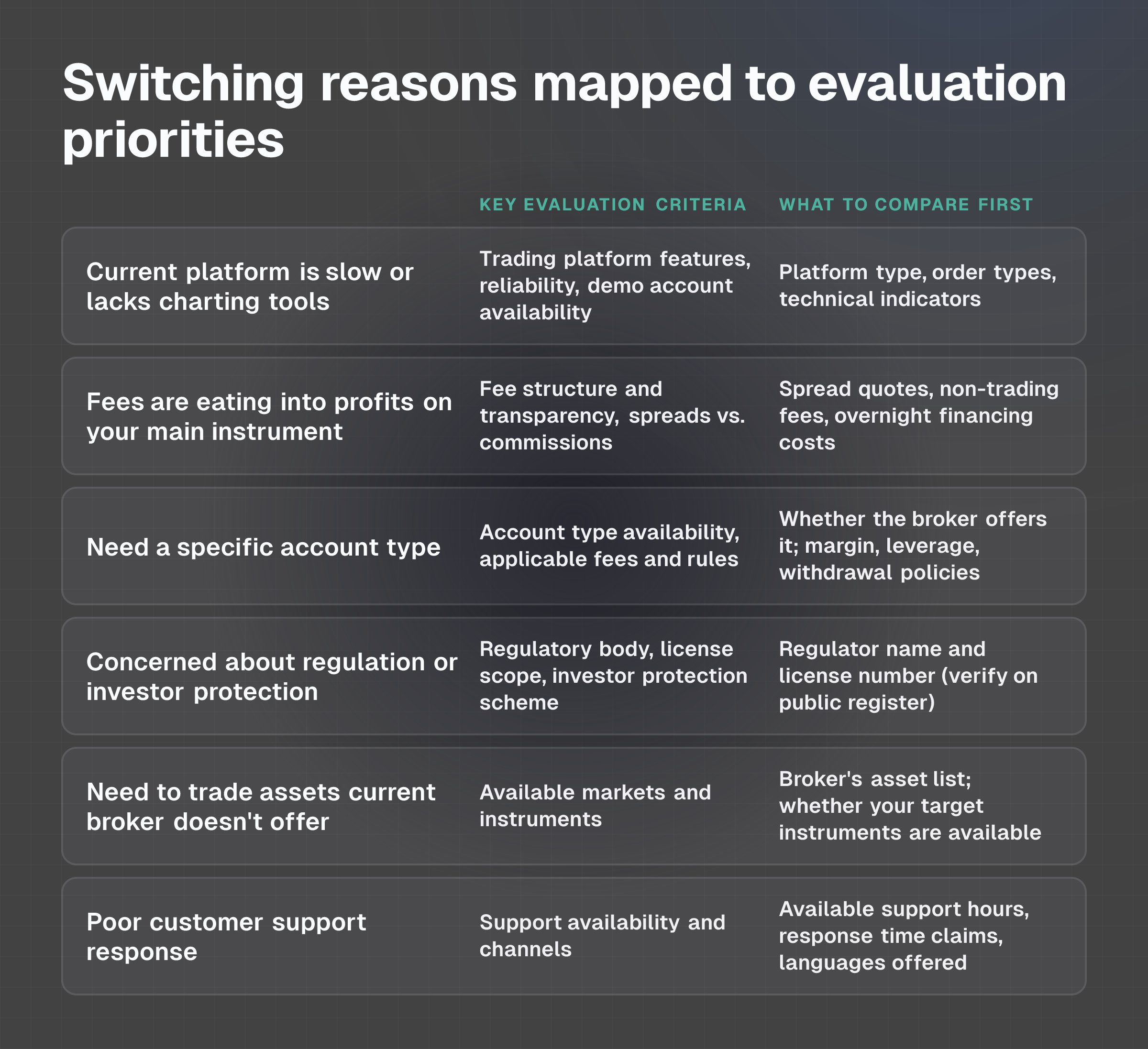
The decision framework below maps common reasons for switching to the criteria that matter most:
| Your primary reason for switching | Key evaluation criteria | What to compare first |
|---|---|---|
| Current platform is slow or lacks charting tools | Trading platform features, reliability, demo account availability | Platform type (web, desktop, mobile), available order types, technical indicators |
| Fees are eating into profits on your main instrument | Fee structure and transparency, spreads vs. commissions on that asset class | Spread quotes (same account type and instrument), non-trading fees, overnight financing costs |
| Need a specific account type (Islamic, joint, corporate) | Account type availability, applicable fees and rules | Whether the broker offers your required account type; margin, leverage, and withdrawal policies for it |
| Concerned about regulation or investor protection | Regulatory body, license scope, investor protection scheme | Regulator name and license number (verify on the regulator's public register), applicable deposit insurance or compensation fund |
| Need to trade assets your current broker doesn't offer (e.g., crypto, bonds, specific indices) | Available markets and instruments | Broker's asset list; whether your target instruments are available |
| Poor customer support response | Support availability and channels | Available support hours, response time claims, languages offered |
This article addresses the broader framework. If your constraint is specific to one asset class, forex trading costs, for example, consult Forex Trading Costs Explained: Compare More Than the Spread for instrument-specific fee breakdowns.
Regulation and investor protection
Regulation is the foundation. A broker regulated by a recognized authority in your region or a major financial hub offers legal recourse and, in many cases, compensation if the broker fails or engages in misconduct.
Key regulators by region:
- UK: Financial Conduct Authority (FCA)
- US: Securities and Exchange Commission (SEC) and Financial Industry Regulatory Authority (FINRA)
- Australia: Australian Securities and Investments Commission (ASIC)
- Cyprus: Cyprus Securities and Exchange Commission (CySEC)
- Germany: German Federal Financial Supervisory Authority (BaFin)
How to verify:
Check the broker's website for license numbers and regulator names. Visit the regulator's official public register and search for the broker by name or license number. Confirm the license is active. Note any restrictions, retail-only, professional opt-up available.
Investor protection schemes:
Many regulated brokers participate in deposit insurance or compensation funds:
- UK (FCA-regulated): Financial Services Compensation Scheme (FSCS) typically covers up to £85,000 per person per institution.
- US (SEC/FINRA-regulated): Securities Investor Protection Corporation (SIPC) typically covers up to $500,000 per customer per firm.
- Australia (ASIC-regulated): Australian Financial Complaints Authority (AFCA) handles disputes; limits apply.
These protections apply to the specific regulated entity and may have exclusions (certain derivatives or offshore accounts, for example). Verify the scope of protection for your account type and jurisdiction.
Fees and costs
A 2024 industry report noted a growing trend towards commission-free stock trading, but cautioned that many brokers offset this with wider spreads on other assets or increased non-trading fees. The cost of trading depends on the asset, account type, and volume.
Fees to compare:
- Trading fees: Spreads (the difference between buy and sell price), commissions per trade, overnight financing charges (swaps).
- Non-trading fees: Deposit and withdrawal fees, account maintenance or inactivity fees, currency conversion charges.
- Hidden fees: Check withdrawal terms, minimum balance requirements, and fees for ancillary services (margin calls, statement requests).
Fee comparison process:
Calculate your typical trading cost for your main instrument: (spread or commission per trade) × (expected trades per month) + monthly non-trading fees. Compare this figure across brokers using the same account type and instrument. Test withdrawal terms. Some brokers impose fees or processing delays that can erode net returns.
Forex Broker Funding Fees: What "Free" Really Covers provides detailed cost breakdowns for common account structures.
Trading platforms and tools
The platform is your interface to the market. You need reliability, user-friendly features, and the tools you actually use: charting, order types, alerts, mobile access. These are essential to execute trades efficiently.
Platform types:
- Web-based: Accessed via browser; no installation required.
- Desktop: Installed software; often more powerful for advanced analysis.
- Mobile apps: For trading on smartphones and tablets; useful for monitoring and quick execution.
- Third-party platforms: MetaTrader 4 (MT4), MetaTrader 5 (MT5), cTrader, and others offer standardized interfaces across brokers.
Key features to test:
Charting tools and technical indicators. Available order types (market, limit, stop-loss, conditional orders). Real-time data and news feeds. Mobile functionality and responsiveness. Demo account availability, this allows you to test without risking capital.
Trading Platform Compatibility: Check Your Broker Account details how to match your preferred platform to broker offerings. MT4 and MT5 Brokers: Compare Account and Platform Access compares MetaTrader access across brokers.
Available markets and account types
Different brokers offer different asset classes and account structures. Confirm the broker supports the instruments you want to trade and offers an account type suited to your capital and strategy.
Asset classes and instruments:
- Stocks and ETFs
- Forex (currency pairs)
- Cryptocurrencies
- Commodities (oil, gold, etc.)
- Indices
- Bonds
- Options
Account types:
- Standard account: For most retail traders; standard margin and leverage.
- ECN account: Direct market access; often lower spreads but may have per-trade commissions.
- Islamic (swap-free) account: Complies with Islamic finance principles; no overnight financing charges, but other fees may apply.
- Demo account: For practice; uses virtual funds.
- Joint, corporate, IRA, or other specialized accounts: Tailored to specific ownership or tax structures.
Verify that your target account type is available and review its margin requirements, leverage limits, and applicable fees. Broker directory provides searchable access to broker catalogs filtered by asset class and account type.
Customer support and educational resources
Responsive, accessible support is critical during market hours or when you encounter technical issues. Educational resources help you develop trading skills and make informed decisions.
Support evaluation:
Test support responsiveness by submitting a question before committing capital. Confirm availability in your language and during your trading hours. Check available channels: phone, email, live chat, ticketing system. Note response time claims and peak-hour wait times if disclosed.
Educational resources:
Webinars and video tutorials. Trading glossaries and strategy guides. Market analysis and economic calendars. Research tools: charting, news feeds, technical analysis.
Relevant account alternatives
If your current broker lacks a specific account type or instrument, consider the following scenarios:
Scenario 1: You need swap-free (Islamic) trading but your current broker doesn't offer it
Why you might need this: You trade frequently and wish to avoid overnight financing charges, or you follow Islamic finance principles.
Trade-off: Swap-free accounts typically eliminate overnight swap charges, but administrators' fees, spreads, or minimum balances may offset this benefit. Not all instruments are available on swap-free accounts. Check the broker's instrument list.
Before switching: Verify that your target broker offers swap-free accounts, confirm which instruments are covered, and compare the total cost (spreads + administrative fees) against your current fees on a swap-inclusive account.
Scenario 2: Your preferred trading platform isn't available
Why you might need this: You rely on MT4 or MT5 charting, or you use a third-party platform your current broker doesn't support.
Trade-off: Brokers offering MetaTrader or cTrader may have slightly higher spreads or fees to cover platform licensing. Proprietary platforms are often optimized for that broker's strengths but lack portability.
Before switching: Confirm the platform is available on your device (web, desktop, or mobile). Test the platform via demo account. MT4 and MT5 Brokers: Compare Account and Platform Access maps platform availability across brokers.
Scenario 3: You need to trade an instrument your current broker doesn't offer
Why you might need this: You want to diversify into crypto, bonds, or a specific commodity index that your current broker doesn't support.
Trade-off: Brokers with wider asset coverage may not specialize in any single market. A niche broker offering deep liquidity in your target instrument might lack offerings in others.
Before switching: Confirm the instrument is available, test execution with a small demo trade, and check if spreads and commissions are competitive for that asset class. Forex Broker vs Stock Broker: Ownership, Costs and Risks clarifies differences between asset-class-specific brokers.
Scenario 4: Regulation or investor protection is inadequate
Why you might need this: Your current broker is unregulated or regulated by an authority with weak enforcement. You want the security of a major regulator and a compensation scheme.
Trade-off: Highly regulated brokers (FCA, SEC, ASIC) enforce strict capital requirements and have robust investor protections, but may impose higher fees or stricter leverage limits.
Before switching: Verify your target broker's regulator on the official register. Confirm the scope of any deposit insurance. Note that regulation tier doesn't guarantee profitability. It protects capital in case of broker failure.
Checks before switching
Before opening an account with a new broker, complete these verification steps:
1. Verify regulation and licensing
Find the broker's license number on its website. Visit the regulator's public register and search by name or license number. Confirm the license is active and check for any enforcement actions or restrictions. Note the scope (retail-only, professional opt-up available).
2. Test the platform via demo account
Open a demo account if available. Practice placing trades and using charting tools. Test order execution speed and available order types. Confirm the platform works on your device.
3. Review the fee schedule
Download or screenshot the current fee schedule. Calculate your typical monthly cost (spread/commission × expected trades + non-trading fees). Verify deposit and withdrawal methods and any associated fees. Check for minimum balance or inactivity penalties.
4. Confirm instrument and account type availability
Search the broker's asset list for your target instruments. Confirm the account type you need (standard, Islamic, ECN) is available. Review margin requirements, leverage limits, and any restrictions on that account type.
5. Check deposit and withdrawal terms
Verify accepted deposit methods and any deposit fees. Confirm withdrawal processing times and fees. Note any minimum withdrawal amounts or holding periods. Check Forex Broker Deposits and Withdrawals: Fees, Times and Checks for detailed guidance on common withdrawal issues.
6. Review the dispute resolution process
Locate the broker's complaints procedure. Confirm whether the broker participates in an independent dispute resolution scheme (FSCS, SIPC, AFCA). Review the scope of any compensation available.
7. Test customer support
Submit a support inquiry before opening an account. Note the response time and quality of assistance. Confirm support is available in your language and during your intended trading hours.
8. Read recent user feedback and reviews
Consult independent review sites and forums. Look for patterns in complaints: withdrawal delays, platform crashes, unresponsive support. Prioritize data-driven comparisons over anecdotal reviews. Use WhatBroker comparisons to evaluate brokers against a structured framework rather than relying on marketing claims alone.
This comparison draws on regulator registers, official fee schedules, platform documentation, and investor guidance from regulatory authorities. Last verified: 12 November 2026.