Forex Broker Funding Fees: What “Free” Really Covers

Forex brokers advertise "free" deposits and withdrawals, but the actual cost depends on your payment method, whether you hit a monthly threshold, and what your bank charges on its end. A deposit the broker calls free might still cost you a wire fee or a currency conversion spread. Withdrawals labeled free often come with a one-per-month limit, cross it, and you'll pay a percentage or flat fee.
This comparison unpacks what five regulated brokers charge upfront, which fees only appear after you exceed a cap, and where regional differences bite. All figures current as of 10 November 2026.
Direct answer and key distinction: What "free" actually covers
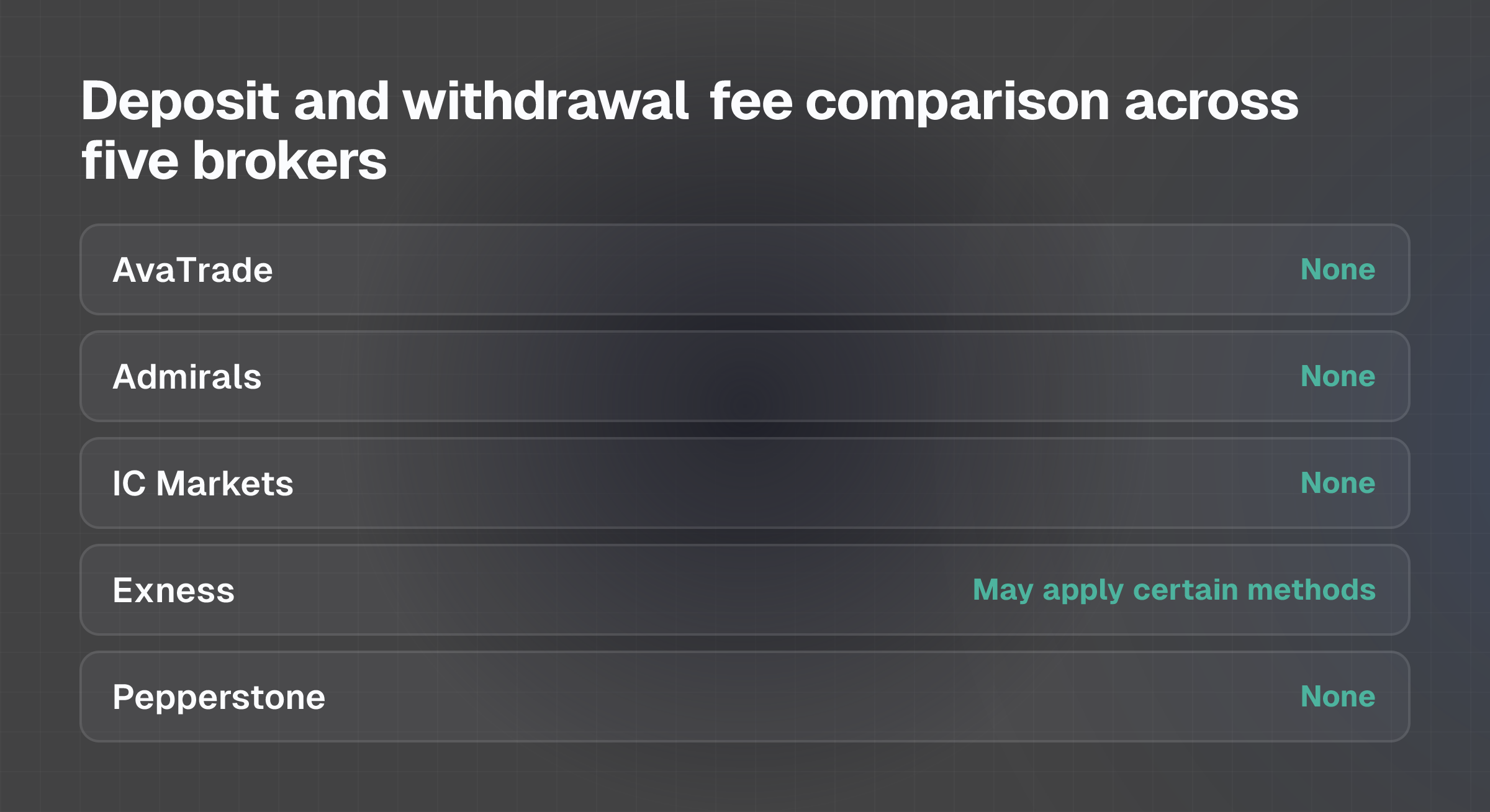
"Free" usually means the broker won't add its own fee. It doesn't cover what your bank, credit card issuer, or payment processor takes.
A bank wire marked free by the broker can still carry a $25 outbound charge from your bank. A card deposit with no broker fee may still incur a 2% currency conversion margin. The real question is whether the broker stacks another charge on top, and whether conditional fees kick in once you've made a certain number of moves.
The table below shows deposit and withdrawal terms for five brokers across common payment rails:
| Broker | Residence | Client Class | Account | Deposit Fee | Withdrawal Fee (First per Month) | Withdrawal Fee (After Limit) | Inactivity Fee | Source |
|---|---|---|---|---|---|---|---|---|
| AvaTrade | Ireland | Retail | Retail | None | None | None | $50/month after 3 months dormant | AvaTrade |
| Admirals | Cyprus | Retail | Trade.MT5 | None | 1 free/month (bank), then €1/$1 | Card 1% min. €1; Skrill 1% min. €1; Brite 1% | €10/month | Admirals |
| IC Markets | Seychelles | Retail | Standard | None | None | None | Not stated | IC Markets |
| Exness | Cyprus | Retail | Standard | May apply to certain methods | None | None | None | Exness |
| Pepperstone | Australia | Retail | Razor | None | None | None | Not stated | Pepperstone |
Key distinction: broker-side free is not total-cost free. Admirals gives you one no-fee withdrawal per month; after that it's 1% or a minimum flat charge depending on method. AvaTrade charges nothing for deposits or withdrawals but imposes a $50 monthly inactivity fee after three consecutive months of no trades. IC Markets and Exness list no withdrawal fees. Pepperstone likewise states none. Inactivity triggers vary: only AvaTrade and Admirals specify recurring charges when your account goes dormant.
How the cost or condition works: Broker charges vs. payment-provider costs
Broker fees and payment-provider fees run on separate tracks. This article covers only what the broker itself charges; costs from Visa, Mastercard, Skrill, correspondent banks, or currency conversion services sit outside the broker's control and fluctuate by your card issuer, country, and the intermediary banks involved.
Deposit charges
Most brokers in this set state zero deposit fee. AvaTrade, IC Markets, and Pepperstone explicitly charge nothing. Admirals lists deposits as free on published methods. Exness notes that fees may apply to specific payment methods, meaning the cost depends on which route you pick, but doesn't itemize them in the public terms.
What varies:
- Whether the broker absorbs payment-processor costs or passes them through
- Currency conversion spreads when you deposit in a non-base currency
- Hold periods before funds clear into your trading balance
Withdrawal charges and thresholds
Withdrawals show the widest spread. The critical line is the monthly allowance:
One free withdrawal per month, then fees apply:
Admirals: Bank transfer costs €1 / $1 / 6 CHF / 25 PLN per withdrawal after the first. Card (Visa/Mastercard) costs 1%, minimum €1 / GBP / USD. Skrill costs 1%, minimum €1 / USD. Brite costs 1%.
Unlimited free withdrawals:
IC Markets, Exness, Pepperstone, AvaTrade: no stated withdrawal fees.
Inactivity fees and dormancy
Once inactivity triggers, monthly charges apply whether you trade or not:
- AvaTrade: $50 per month after three consecutive months of no trades.
- Admirals: €10 per month (trigger point not covered in the available documentation).
- IC Markets, Exness, Pepperstone: no inactivity fee mentioned.
One worked example or checklist: Net receipt calculation for a €500 withdrawal
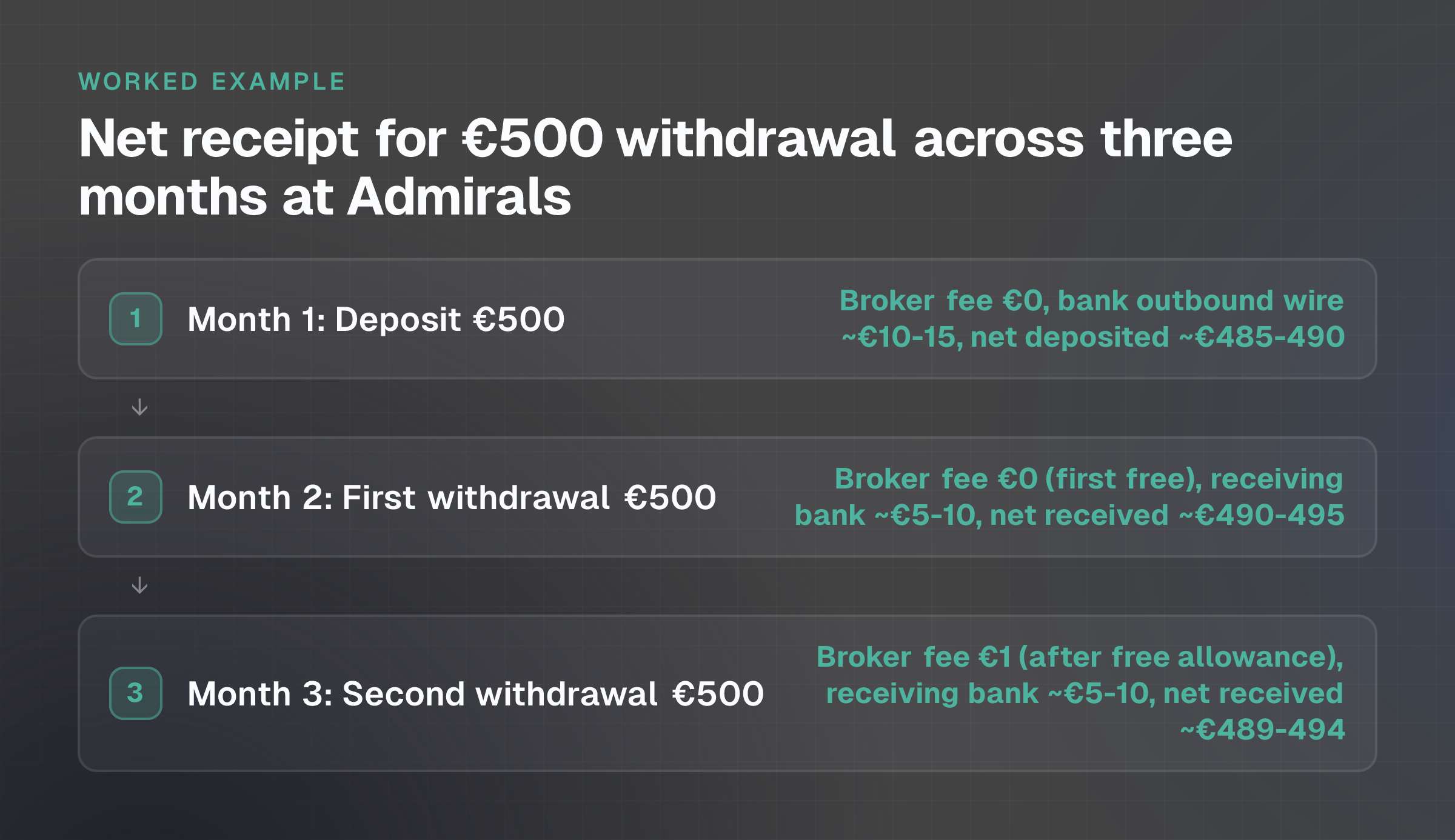
Scenario: You deposit €500 into a Trade.MT5 account at Admirals (Cyprus entity, CySEC 201/13), fund via bank transfer in your first month, then withdraw €500 via bank transfer in your second month.
Month 1, Deposit:
- Broker deposit fee: €0
- Payment provider charge (outbound wire): varies by your bank, assume €10-15 (the broker doesn't charge this)
- Net deposited to account: roughly €485-490
Month 2, First withdrawal:
- Amount requested: €500
- Broker withdrawal fee (first of the month): €0
- Receiving bank fee (incoming wire): €5-10 (outside broker control)
- Net received: roughly €490-495
Month 3, Second withdrawal (hypothetical):
- Amount requested: €500
- Broker withdrawal fee (second withdrawal in the same month): €1 (Admirals' stated charge for bank transfer after the first free withdrawal)
- Receiving bank fee: €5-10
- Net received: roughly €489-494
Checklist before you withdraw:
- How many free withdrawals your account permits per month (Admirals = 1; others = unlimited or unstated).
- Which payment method you're using and whether it has a stated broker fee after the free allowance.
- Your bank's incoming wire charge, separate from any broker fee.
- Whether inactivity fees have started (check statements for monthly deductions).
- Settlement time (typically 3-5 business days for bank wires; varies by country and correspondent banks).
Checks before choosing an account: Fee transparency and regional limits
Before you open an account, nail down these points:
Deposit method availability in your region. Not every payment rail works everywhere. Exness states certain methods may carry deposit fees, clarify which ones before you fund.
Withdrawal frequency and your usage pattern. If you plan to withdraw twice a month or more, Admirals' one-free-per-month structure costs more than IC Markets or Pepperstone, which list no per-transaction charges. Multiply your likely annual withdrawal count by the per-transaction fee to see the real cost.
Inactivity trigger and your trading cadence. AvaTrade bills $50 per month after three consecutive months idle. If you trade intermittently, confirm whether your account type has the same threshold or a different one.
Minimum deposit and account access. AvaTrade sets a $100 minimum; Admirals' Invest.MT5 allows $1. Small initial deposits may lock you into certain account types or exclude some payment methods. Verify availability in your jurisdiction and under your client classification (retail or professional).
Currency mismatch between fee and base account. Admirals quotes withdrawal fees in multiple currencies: €1, CHF 6, PLN 25, SEK 50, USD 1. If your account base is USD but you withdraw to a EUR bank, confirm which fee applies and whether any conversion spread attaches.
Regulation and client protection. Admirals (Cyprus entity CySEC 201/13, UK entity FCA 595450) offers €100 000 investor compensation under CySEC rules. AvaTrade (Ireland, Central Bank C53877) and IC Markets (Seychelles FSA SD018, Cyprus CySEC 362/18) operate under different regimes. Regulation shapes complaint resolution and fund segregation, but it doesn't eliminate the risk inherent in leveraged CFD or forex trading.
For step-by-step account setup, deposit routing, and transfer mechanics, see the funding guide for forex accounts. To compare spread costs, commission structures, and overnight financing across these brokers, review individual broker pages or use the broker comparison tool.
Last verified: November 10, 2026