Forex Broker Deposits and Withdrawals: Fees, Times and Checks

Funding your forex trading account requires moving money through regulated channels with verification at each stage. Your broker must verify your identity and address before deposits are accepted, a regulatory requirement enforced by the Financial Conduct Authority (FCA), Cyprus Securities and Exchange Commission (CySEC), and the Australian Securities and Investments Commission (ASIC). The deposit methods available, fees charged, and settlement times depend on your region, your broker's payment processors, and anti-money laundering (AML) rules. This guide walks you through identifying the right deposit method, completing verification, understanding processing and settlement timelines, and confirming withdrawal eligibility before transferring funds.
Data in this article has been verified recently.
What to identify first: Your broker's regulated entity and deposit terms
Open your broker's account agreement and deposit page. You need to establish which entity holds your account and what funding options exist in your region.
Start by confirming the regulated entity serving your account. The agreement should state the legal name of the entity, the financial regulator overseeing it (FCA, CySEC, ASIC, or another authority), and the licence or registration number. This entity is what you rely on for regulatory protection. Group-level licences don't automatically cover every account; the contracting entity matters.
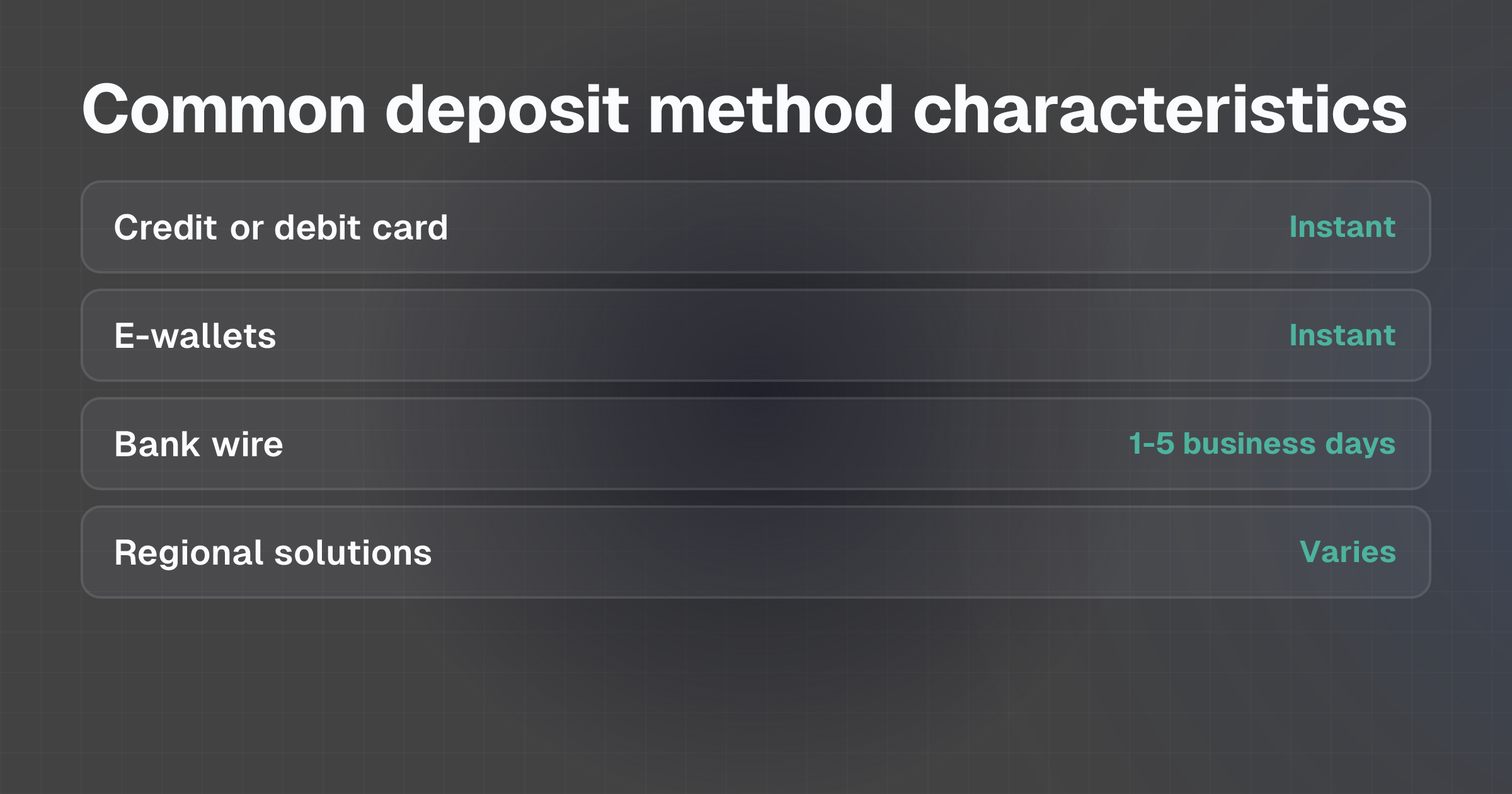
Next, identify the deposit methods available to you. These vary by region and may include bank transfer (domestic or international wire), credit or debit card, e-wallets (such as Neteller or Skrill), and regional payment solutions (such as M-Pesa in Kenya or local bank transfers in Southeast Asia).
For each method, record minimum and maximum deposit amounts, stated deposit fees charged by the broker or payment processor, processing time ranges (instant for cards and e-wallets; typically 1-5 business days for bank wires), currency conversion fees if your deposit currency differs from your account's base currency, and the account base currency itself, the primary currency in which your trading account is denominated.
Don't assume all payment methods are available in your country. Regional availability varies significantly.
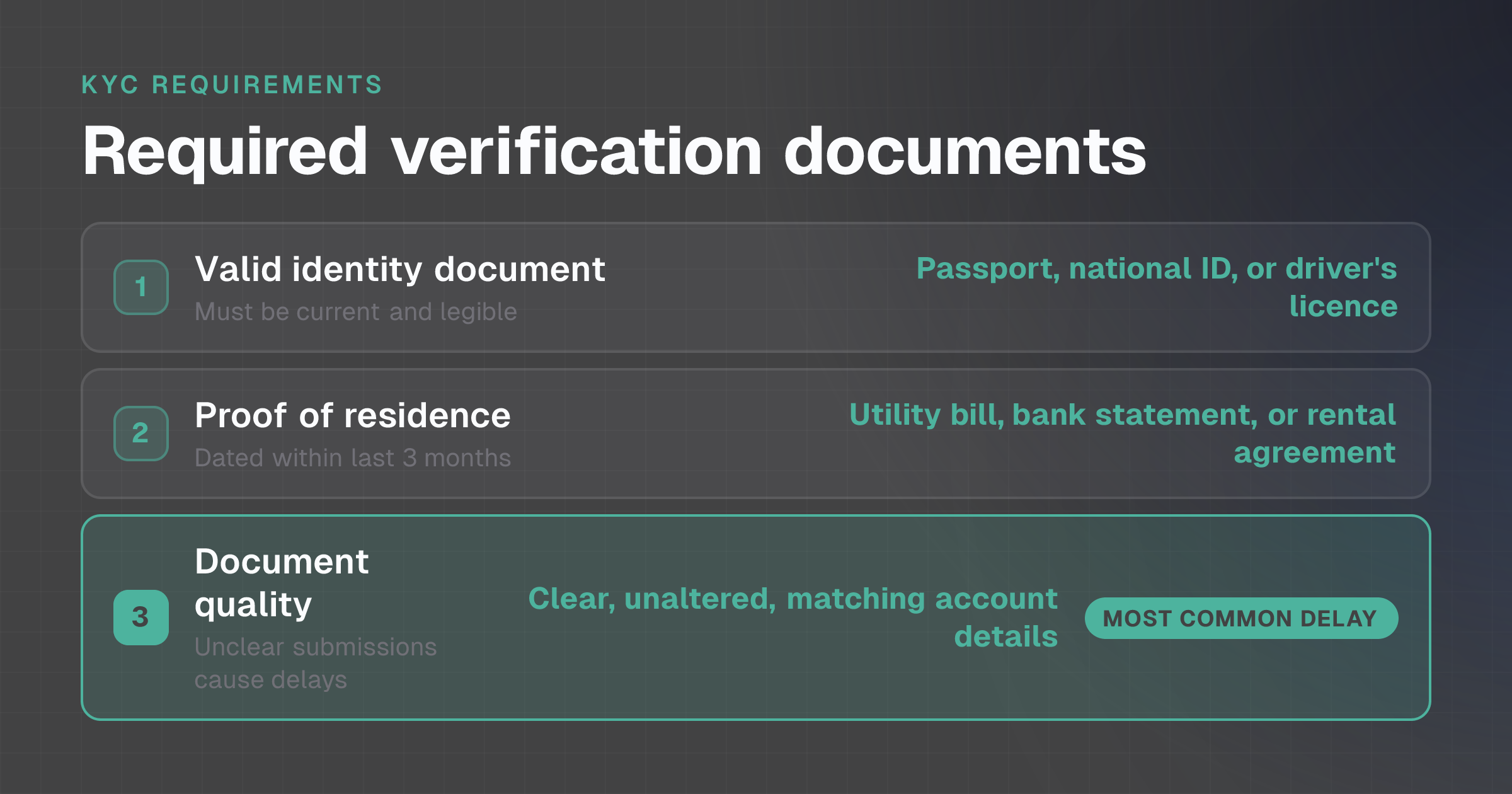
Finally, check the KYC (Know Your Customer) requirements. The broker will specify identity documents required (passport, national ID, or driver's licence), proof of residence documentation (utility bill, recent bank statement, or similar), and whether documents must be submitted before or after your first deposit.
Verification steps: Identity, residence, and deposit eligibility
Before you deposit, you must complete Know Your Customer (KYC) and Anti-Money Laundering (AML) verification. This is a mandatory regulatory step, not optional.
Identity and residence verification
Upload the documents requested by your broker: a clear copy of a valid identity document (passport, national ID, or driver's licence) and a proof of residence document dated within the last 3 months (utility bill, bank statement, rental agreement, or similar). Documents must be legible, valid, and match the details in your account. Unclear or mismatched information causes delays.
Await broker review and approval. This can take from a few hours to several business days, depending on the broker's processing speed and document quality. Incomplete submissions are the leading cause of verification delays.
Why this matters for deposits and withdrawals
AML rules require that withdrawals must return to the original source of deposit. If you used multiple deposit methods, the broker may require withdrawals proportionally to each source. This isn't broker discretion, it's regulatory compliance. Understanding this rule upfront prevents withdrawal rejection later.
Interpret the result: What deposit confirmation means and what it doesn't
Once your KYC verification is approved and your first deposit clears, you can trade. However, understanding what happens behind the scenes helps you avoid common delays.
Processing time versus settlement time
These aren't the same. Processing time is how long the broker takes to accept and initiate your deposit. For cards and e-wallets, this is often instant. For bank transfers, it typically ranges from 1-5 business days. Settlement time is how long the underlying funds take to reach the broker's account with the payment processor. Even after your trading account shows the credit, the funds may still be settling on the payment network.
Many brokers allow instant trading on card and e-wallet deposits, but the underlying funds may take longer to fully settle. This can affect your ability to withdraw immediately, depending on the broker's policy.
What verification confirms and what it doesn't
Completing KYC verification confirms that your identity and address have been checked against regulatory standards, you're eligible to trade on that account, and your account meets regulatory requirements for that jurisdiction.
Verification does not confirm the safety or security of the broker itself (that requires separate regulatory oversight review), that all deposit fees have been disclosed (payment processors may charge fees not listed on the broker's deposit page), or that your withdrawal will be instant or fee-free (settlement depends on the payment method and your bank or e-wallet provider).
When to stop and ask for clarification
If your verification is rejected, ask your broker support team why. Common reasons include documents that aren't legible or are expired, proof of residence that's too old (typically older than 3 months), personal details in your documents that don't match your account registration, and duplicate accounts flagged by AML systems.
Don't attempt to circumvent KYC by using false information or another person's documents. This violates AML regulations and will result in account suspension and potential legal action.
What to save or ask next: Deposit confirmation, fee records, and withdrawal preparation
Save all confirmation details after your deposit clears: the deposit confirmation number or transaction ID from the broker, payment processor receipt (from your bank, card issuer, or e-wallet), stated processing and settlement times from your broker's terms, and any fees charged, broken down by source (broker fee, currency conversion fee, payment processor fee).
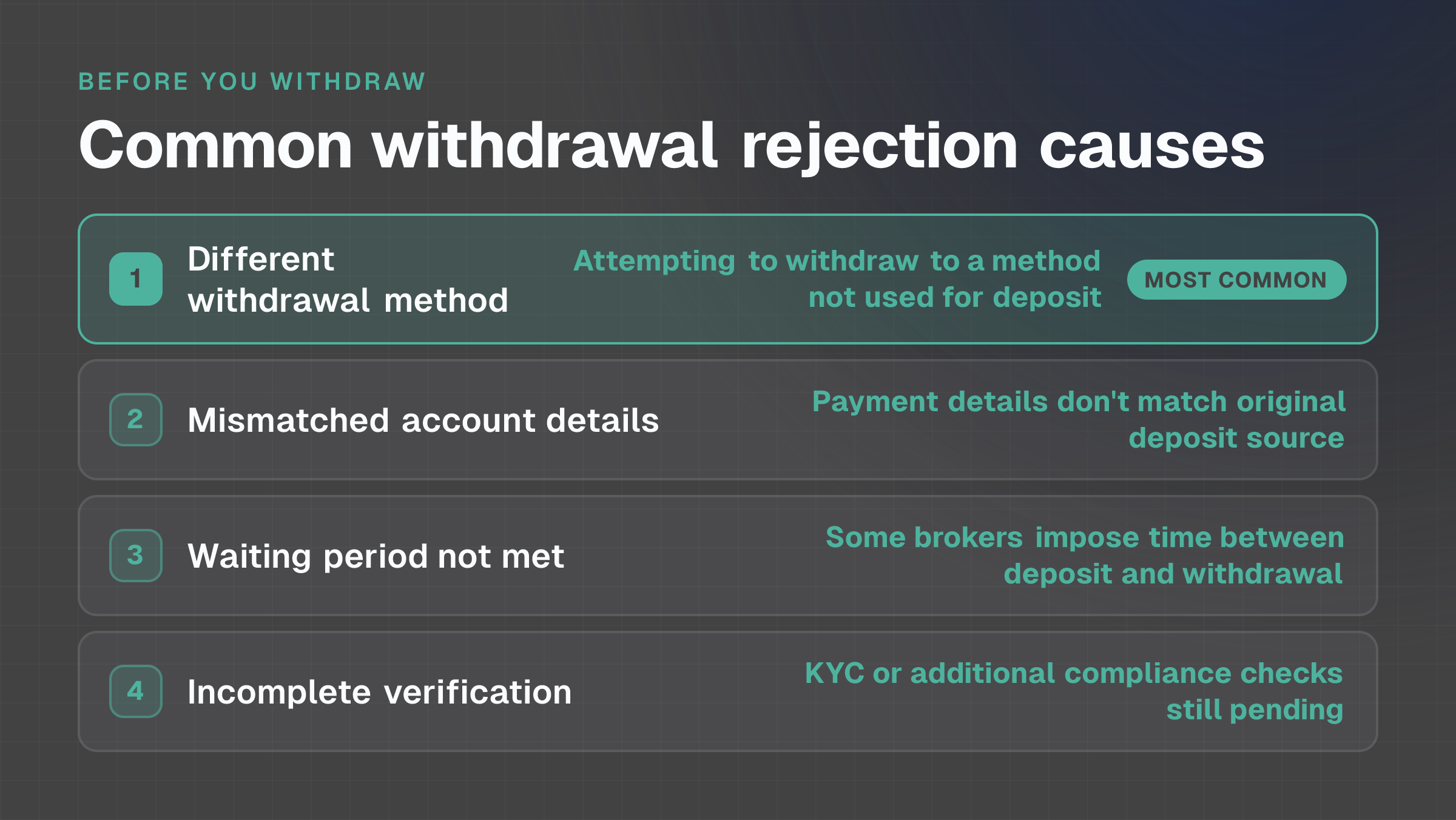
Before initiating a withdrawal, confirm with your broker which withdrawal methods are available to you, whether withdrawals must return to the original deposit source (they almost always must, per AML rules), the withdrawal processing time (typically 1-3 business days for broker review, then 1-5 business days for payment processor settlement), any minimum or maximum withdrawal amounts, and whether a waiting period applies between deposit and withdrawal (some brokers impose this for compliance reasons).
If a withdrawal is rejected, the most common reason is attempting to withdraw to a different account or method than the original deposit source. Verify the payment details match exactly and resubmit to the correct source.
Review your broker's account agreement and How to Choose a Forex Broker: Costs, Rules and Platforms for additional context on fees, regulation, and terms before funding your account. Check the broker directory to verify the regulated entity and terms for your specific broker.