Forex Trading Costs Explained: Compare More Than the Spread

Trading costs decide whether a trade is profitable or expensive before you enter. The total includes the spread, the gap between bid and ask, any commission per trade, overnight financing if you hold past market close, and less visible charges like currency conversion markups or withdrawal fees. A broker with tight spreads may charge commissions that kill frequent trading. Another offers commission-free accounts but widens spreads to compensate.
This article compares how different account types structure these costs. You'll shortlist accounts that match your trading approach rather than chasing a single headline number.
The costs that matter depend on frequency and hold time. A scalper pays spreads and commissions on dozens of trades daily; tight execution pricing is everything. Swing traders hold overnight. They care less about per-trade costs, more about swap fees and inactivity charges. Long-term investors prioritize deposit and withdrawal fees, currency conversion, dormancy penalties. Before comparing accounts, identify your style and examine the fee schedule that matches it, not the zero-commission claim alone.
Eligible accounts at a glance
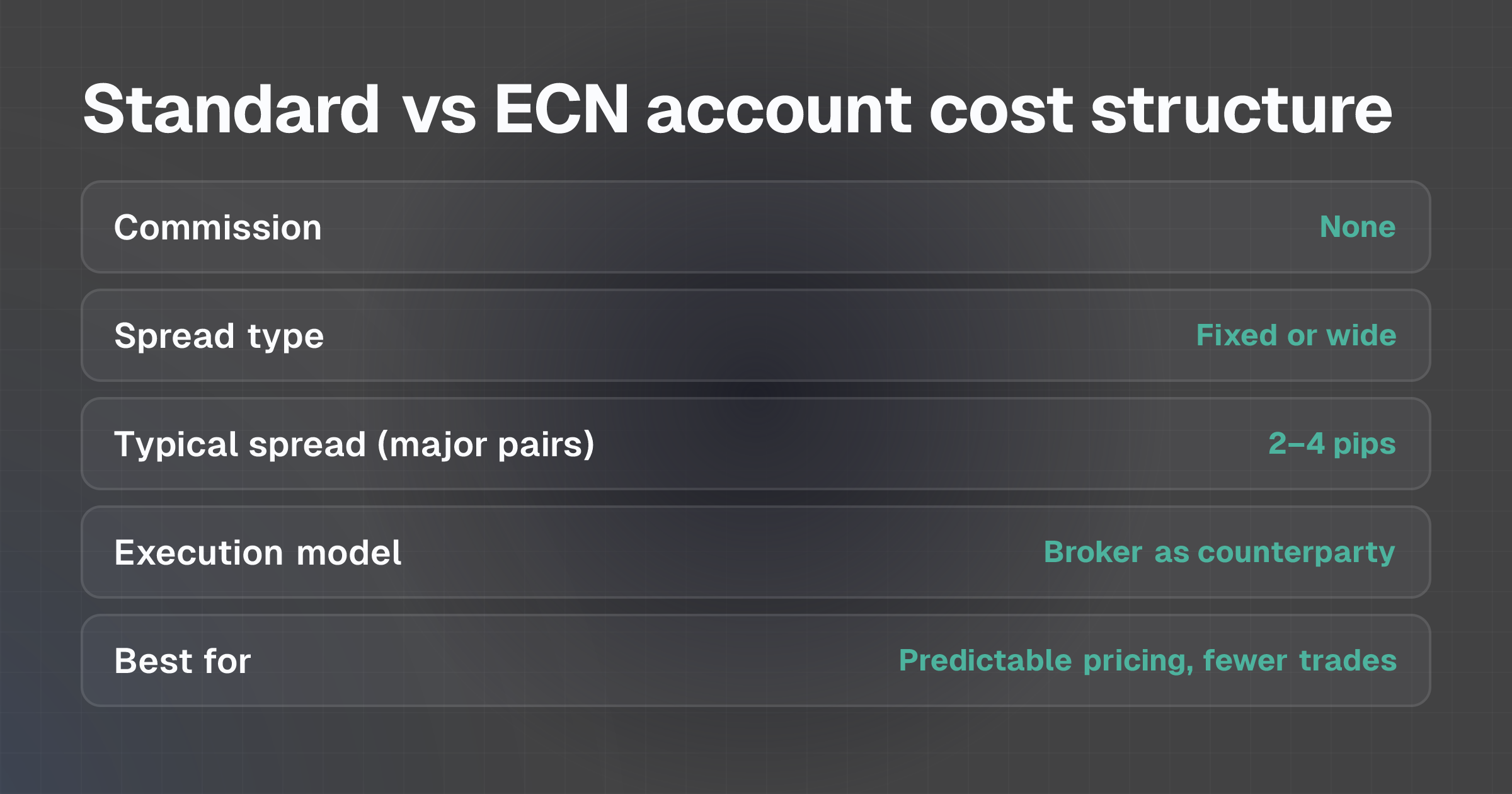
Brokers offer accounts in one of two execution models. Each has a distinct cost structure and a trade-off between spreads and commissions.
Standard (Retail/Market Maker) Accounts charge no commission but widen the spread. The broker acts as counterparty, profiting from the spread markup rather than a per-trade fee. These suit traders who prefer predictable all-in pricing and place fewer trades. Spreads on major forex pairs range from 2 to 4 pips during normal hours, wider during news events or illiquid periods.
ECN/STP Accounts charge a commission per trade but offer tighter, variable spreads. Trades route directly to liquidity providers, banks or other brokers, and the broker profits from the per-lot fee rather than the spread. Spreads on ECN accounts fluctuate based on market volatility, liquidity, and supply-demand conditions. These accounts suit high-frequency traders and those seeking direct market access.
Each model trades simplicity for cost structure. Standard accounts appeal to traders who value ease of understanding. ECN accounts appeal to those prioritizing execution tightness at the cost of per-trade fees.
Selection criteria and date
Last verified: November 2, 2026
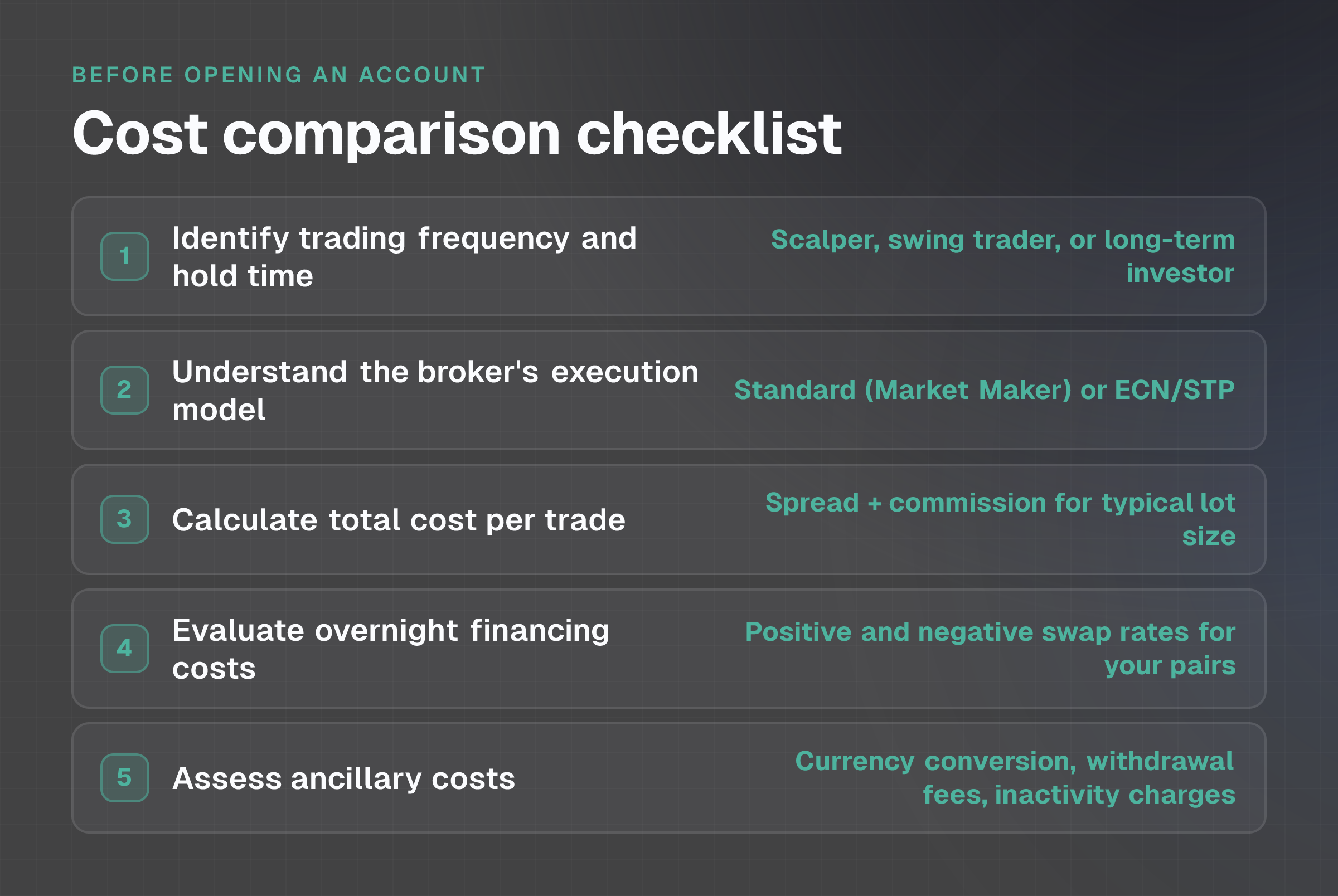
When choosing between account types, map your trading style to the cost structure that minimizes total outlay:
Identify Your Trading Frequency and Hold Time
Scalpers and day traders prioritize low spreads and commissions due to high trade volume. Each pip or fraction of a pip compounds across dozens of daily trades. Swing traders hold positions for days or weeks. Focus on competitive overnight financing costs (swap rates) and variable spreads. Per-trade commissions matter less than all-in spread cost on individual trades. Long-term investors trade infrequently. Consider deposit and withdrawal fees, currency conversion markups, and inactivity charges as primary concerns.
Understand the Broker's Execution Model
Standard (Market Maker) accounts offer fixed or predictable spreads and no commissions. Suitable for less frequent traders who prefer knowing the all-in cost upfront. ECN/STP accounts provide variable spreads and per-trade commissions. Suited for high-frequency traders and those seeking measurably tighter baseline pricing.
Calculate Total Cost Per Trade
For commission-free accounts: Spread (in pips) × pip value × lot size. For commission-based accounts: (Spread in pips × pip value × lot size) + Commission per lot or trade. Compare the all-in cost across account types for a trade size typical to your approach.
Evaluate Overnight Financing (Swap) Costs
Critical for swing and position traders. Check positive and negative swap rates for the currency pairs or assets you trade. A positive swap is a credit; a negative swap is a charge applied when you hold a position past the market close (typically 5 PM ET for forex and CFDs).
Assess Ancillary Costs
Currency conversion: Is there a fixed percentage markup or flat fee when trading an asset in a currency different from your account base? Deposit and withdrawal: Are there fees for your preferred payment methods? Inactivity: What's the dormancy period, and what fee applies if the account falls inactive? Guaranteed Stop-Loss Orders (GSLO): If you use guaranteed stops for risk management, what's the premium cost?
Account comparisons and limitations
Spread and Commission Trade-offs
Standard accounts advertise zero commission but offset this with wider spreads. On a major forex pair during normal hours, you might see 2-4 pip spreads with no per-trade fee. An ECN account on the same pair might offer 0.5-1.5 pip spreads but charge 1-2 pips in commission per round-trip trade (expressed as cost per lot). The total all-in cost depends on your trade size and frequency.
For a 1 standard lot trade on a major pair: Standard account yields 3 pips spread × $10 per pip = $30 per trade (no commission). ECN account yields 1 pip spread × $10 per pip + 1.5 pips commission × $10 per pip = $25 per trade.
The ECN account is cheaper per trade if you execute the same strategy. But if you scalp 50 trades daily versus holding a handful of swing positions weekly, the relative impact of per-trade fees reverses the equation.
Variable Spread Risk
Variable spreads on ECN accounts widen during news events, low liquidity periods, or high volatility. Spreads that average 0.5-1 pip during calm hours may expand to 5-10 pips during economic data releases or market gaps. This unpredictability increases slippage risk: the difference between your expected execution price and the actual price at which your trade fills. Traders using tight stop-losses face enlarged risk if spreads widen at the moment of entry or exit.
Standard (fixed-spread) accounts reduce this unpredictability. However, the fixed spread is set by the broker and may be wider than ECN quotes during both calm and volatile periods.
Overnight Financing (Swap) Costs
Positions held past market close incur an overnight financing charge or credit, calculated as a swap rate. For forex pairs, this reflects the interest rate differential between the two currencies. The direction and size of the charge depend on the specific pair, your position direction (long or short), and the broker's financing schedule.
A swing trader holding a position for 5 days might pay or receive $5-$20 per trade in cumulative swap charges, depending on the pair and position size. Over weeks or months, swap costs can erode or enhance profitability significantly. This cost applies to both standard and ECN accounts but may vary in absolute terms depending on the broker's financing structure.
Ancillary Fees and Hidden Costs
A "zero commission" claim can be misleading if offset by high currency conversion markups (e.g., 1-2% above interbank rates), withdrawal fees for certain methods, or inactivity charges. Review the broker's full fee schedule, including:
Currency conversion: Fixed or percentage-based markup when trading or withdrawing in a currency other than your account base. Withdrawal methods: Some payment methods (bank wire, e-wallet) may carry different fees. Inactivity fees: Charges applied if the account shows no trading activity for a specified period (often 3-6 months).
Thoroughly reviewing the broker's published fee schedule is essential to avoid unexpected costs eroding your account balance.
Which conditions fit each need
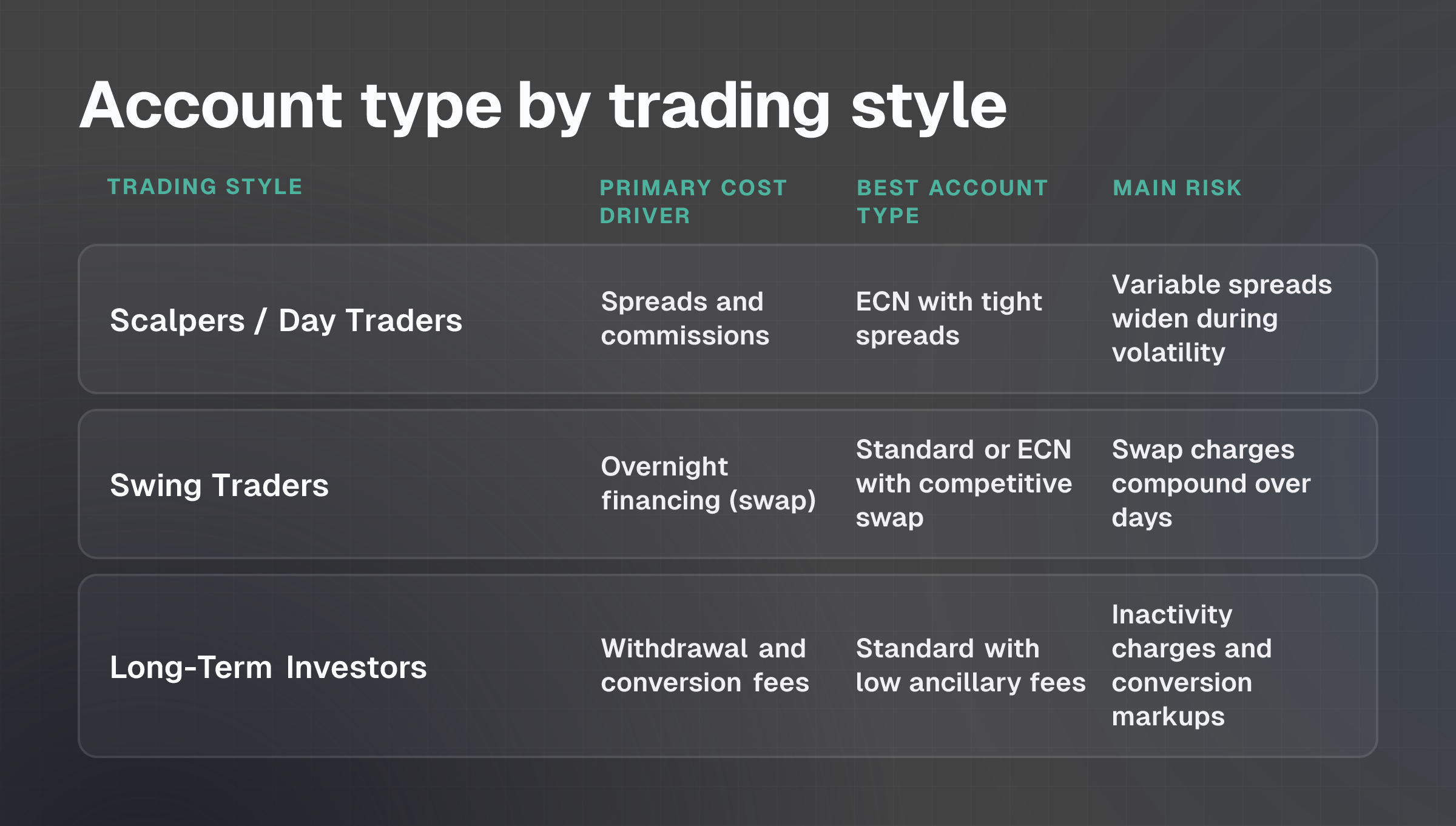
Best for Scalpers and Day Traders
High-frequency trading demands the lowest per-trade cost. ECN accounts with tight variable spreads and commission structures often minimize total cost if you execute many trades daily. A 0.5 pip tighter spread compounded across 50 daily trades saves $500 per day on 1 standard lot per trade (at $10 per pip). Fixed-spread standard accounts suit scalpers only if the headline spread is materially tighter than typical ECN spreads on your target pairs.
Avoid if you hold positions overnight frequently. Swap charges on short-term scalps held past close add unnecessary cost.
Main pros: Tight baseline execution pricing; predictable per-lot fees; direct market access.
Main cons: Variable spreads widen during volatility; slippage risk increases in low-liquidity periods; commissions compound on high trade counts.
Best for Swing Traders
Swing traders typically hold 2-5 days per position. The primary cost driver is the all-in spread cost per trade, followed by overnight financing rates. Fixed-spread standard accounts reduce uncertainty; variable-spread ECN accounts reduce per-trade cost but introduce spread widening risk. Prioritize brokers with transparent, competitive swap rates for your target pairs. Inactivity fees are less of a concern if you trade regularly but matter if you occasionally leave positions open for weeks.
Avoid if you need guaranteed stop-loss protection regularly. GSLO premiums aren't justified for traders holding only a few days.
Main pros: Moderate spreads; known financing costs; no pressure to trade daily.
Main cons: Overnight financing charges or credits can exceed per-trade spread savings; swap rates vary significantly between brokers; wider effective spreads if ECN spreads spike during your entry/exit window.
Best for Long-Term Investors
Long-term investors trade infrequently and hold positions for weeks or months. The primary cost drivers are deposit and withdrawal fees, currency conversion markups, and inactivity charges, not per-trade spreads or commissions. A standard account with predictable spreads and no commission may be adequate. Focus instead on minimizing conversion markups and withdrawal fees for your preferred payment methods. Confirm that inactivity fees don't apply or apply only after 12+ months of dormancy.
Avoid if you plan to access your funds within days or convert between multiple currencies frequently. Repeated withdrawal and conversion fees erode long-term returns.
Main pros: Low per-trade costs are irrelevant; spreads are a small component of total cost; commissions, if any, are negligible over long hold periods.
Main cons: Swap charges compound over extended hold periods; currency conversion markup applied to deposits and withdrawals; inactivity fees apply if account sits dormant; limited liquidity access if dormancy policies restrict trading.
For All Traders: Common Costs to Compare
Across all styles, measure and compare the following before opening an account:
All-in cost per typical trade: (Spread + Commission) for your standard lot size and instrument. Overnight financing rates: Positive and negative swap rates for the pairs or assets you trade. Deposit and withdrawal fees: Fees for your preferred payment method, stated in currency and absolute or percentage terms. Currency conversion markups: Percentage markup above interbank rates if you deposit or trade in a currency other than your account base. Inactivity threshold and fee: Period of inactivity triggering a charge, and the fee amount or percentage.
Document these across 2-3 brokers using the same trade parameters, pair, size, hold period, deposit currency, to make a direct comparison. A broker with 0.5 pip tighter spreads but 50% higher withdrawal fees may not be cheaper overall.