Forex Broker vs Stock Broker: Ownership, Costs and Risks

When you open a brokerage account, what you're buying varies dramatically. Direct shares give you legal ownership of a company stake. CFDs, contracts for difference, deliver price exposure without ownership. Forex contracts let you speculate on currency pairs, typically through leveraged derivatives. The distinctions shape costs, risk, voting rights, dividend treatment, and what happens if the broker collapses. This guide compares XM, Bullwaves, Vantage Markets, and NextTrade across product ownership, fees, account structures, and minimum deposits. Data verified 11 November 2026.
Cash shares, share CFDs, and retail forex contracts: core differences
Cash Shares (Direct Equity): You buy actual shares and become a legal owner of that slice of the company. The broker holds them in custody on your behalf. You receive voting rights and dividends when declared. You pay full market value, or trade on margin by borrowing part of the cost, and profit or loss reflects share price movement plus dividends. Eligible holdings can transfer between brokers in kind where both providers support the transfer.
Share CFDs: A derivative contract between you and the broker to exchange the difference in a share's price from open to close. You don't own the underlying share and have no vote. Dividends aren't paid directly, but your account may be adjusted to reflect them: long positions usually receive a credit, short positions incur a debit. CFDs are leveraged, so you control a larger position with smaller capital. That amplifies gains and losses. Financing charges apply to positions held overnight.
Retail Forex Contracts: Speculation on exchange-rate moves between two currencies. The legal structure varies by jurisdiction and broker, but commonly they're offered as CFDs or similar derivatives. You don't own physical currency; your exposure is to the price difference of the pair. Forex contracts are almost always leveraged. Holding overnight usually incurs swap fees or rollover interest. Ownership of the underlying asset isn't transferred.
Conditional alternatives and table: Product ownership and cost structure
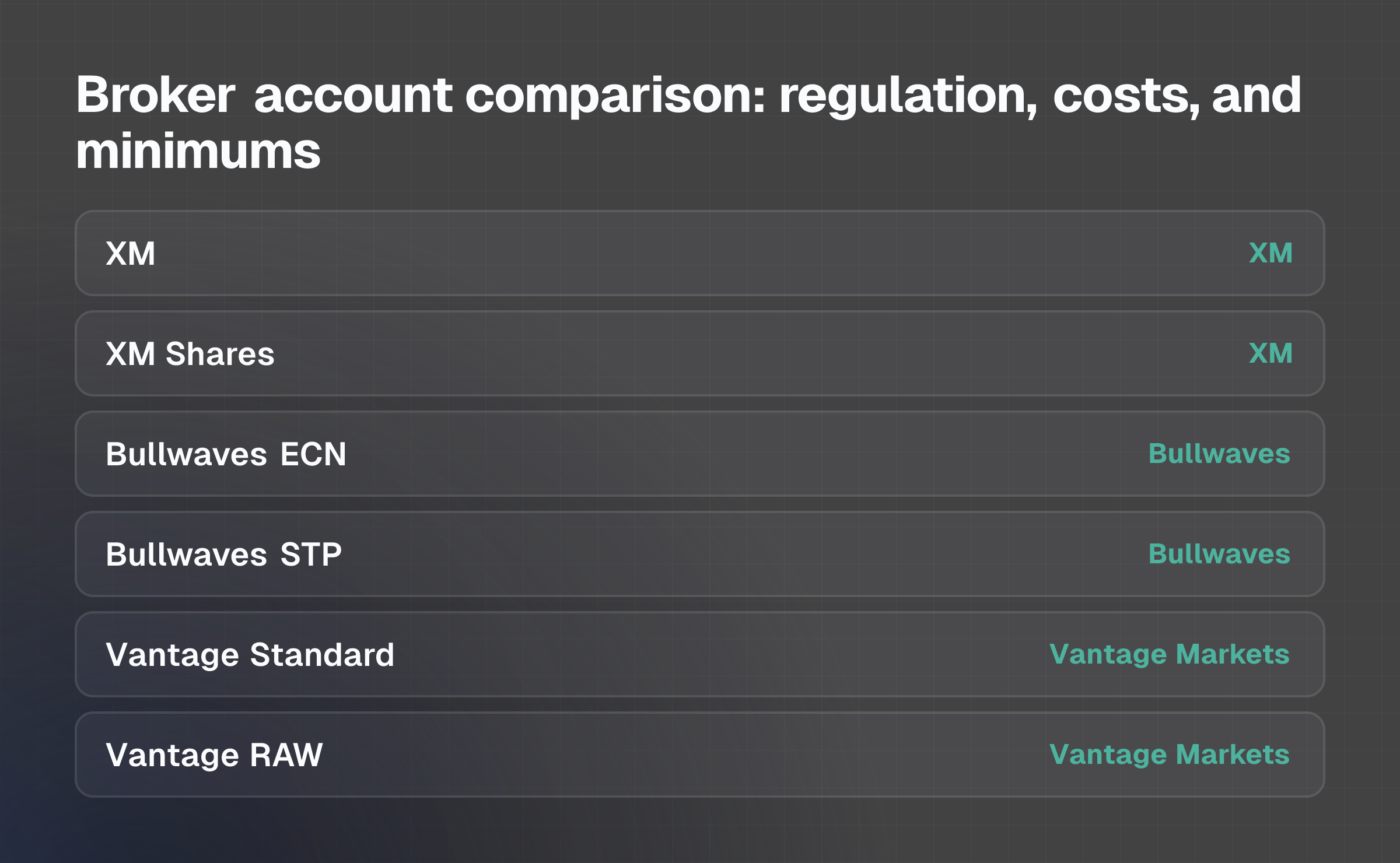
The table below compares four brokers across regulation, account structure, instruments, costs, and minimum deposits. Tier 1 refers to authorities such as the UK FCA or Australian ASIC. Tier 2 includes regional bodies like FSC Mauritius. Tier 3 denotes jurisdictions with lighter oversight.
| Broker | Primary Regulation | Account Type | Instruments | Spread (EUR/USD basis) | Commission | Minimum Deposit (USD) | Platforms |
|---|---|---|---|---|---|---|---|
| XM | Tier 1: CySEC (120/10), DFSA (F003484) | Standard / High Volume | Forex, indices, commodities, stocks (CFDs) | 0.8 pips | Zero | $5 | MT4, MT5 |
| XM | Tier 1 / Tier 2-3 | Shares Account | Stocks (direct ownership) | Spread data not covered in this comparison | Zero | $10,000 | MT4, MT5 |
| Bullwaves | Tier 2: FSA Seychelles (SD185) | ECN Account | Forex, indices, commodities, stocks, metals, ETFs (CFDs) | 0.1 pips raw | Commission per lot | $5,000 | MT4, MT5, web, Autochartist |
| Bullwaves | Tier 2: FSA Seychelles (SD185) | STP / Swap-Free | Forex, indices, commodities, stocks, metals, ETFs (CFDs) | 1.6 pips | None | $100 | MT4, MT5, web, Autochartist |
| Vantage Markets | Tier 1: ASIC (428901), FCA (590299) | Standard STP | Forex, indices, commodities, stocks, ETFs, bonds, metals, energies (CFDs) | 1.1 pips | Zero | $50 | MT4, MT5, web, TradingView, copy trading |
| Vantage Markets | Tier 1: ASIC, FCA | RAW ECN | Forex, indices, commodities, stocks, ETFs, bonds, metals, energies (CFDs) | 0 pips | $3 per lot per side ($6 round trip) | $50 | MT4, MT5, web, TradingView, copy trading |
| Vantage Markets | Tier 1: ASIC, FCA | PRO ECN | Forex, indices, commodities, stocks, ETFs, bonds, metals, energies (CFDs) | 0 pips | $1.50 per lot per side | $10,000 | MT4, MT5, web, TradingView, copy trading |
| NextTrade | Tier 2: FSC Mauritius (GB25204563) | Standard | Forex, indices, commodities, stocks (CFDs) | 1.3 pips | Zero | $25 | MT4, MT5 |
| NextTrade | Tier 2: FSC Mauritius (GB25204563) | Raw | Forex, indices, commodities, stocks (CFDs) | 0.2 pips | $7 per lot round trip | $100 | MT4, MT5 |
| NextTrade | Tier 2: FSC Mauritius (GB25204563) | VIP | Forex, indices, commodities, stocks (CFDs) | 0.0 pips | $4 per lot round trip | $10,000 | MT4, MT5 |
Reason for selection: When to choose direct shares versus CFDs
Direct shares (XM Shares Account, $10,000 minimum):
Pick this if you want to hold equity stakes for dividends, voting rights, or long-term wealth building. XM's Shares Account offers zero commission on direct stock purchases. You own the underlying asset, which provides legal protection through custody arrangements. The trade-off? A higher minimum deposit and zero leverage. This suits investors, not active traders.
CFDs on stocks, forex, or indices (XM standard, Bullwaves, Vantage Markets, NextTrade):
Pick CFDs if you want to speculate on price moves with leverage, trade on margin, or move in and out of positions fast without owning the asset. CFDs allow smaller minimum deposits, XM at $5, Bullwaves STP at $100, Vantage at $50, NextTrade at $25, and give you access to multiple asset classes on one platform. The trade-offs are overnight financing charges, no voting rights or actual dividends (though dividend adjustments may apply), and the derivative structure means you don't own the asset. CFDs suit short-term traders and those seeking leverage.
Regulation tier as a selection factor:
Tier 1 brokers, XM's CySEC and DFSA licences, Vantage Markets' ASIC and FCA licences, operate under stricter oversight, client fund segregation, and conflict-of-interest rules. Tier 2 and Tier 3 brokers like Bullwaves and NextTrade may offer competitive spreads and higher leverage but operate under lighter supervision. The choice depends on whether you prioritize regulatory oversight or specific features like lower minimums or higher leverage.
Low-cost entry (under $100 minimum deposit)
XM Standard ($5 minimum, 0.8 pips EUR/USD, zero commission):
Best for new traders wanting to learn forex or CFD trading with minimal capital and negative balance protection. Avoid if you need tight spreads; 0.8 pips is wider than ECN alternatives.
Bullwaves STP ($100 minimum, 1.6 pips EUR/USD, zero commission, swap-free option):
Best for traders in regions where XM's Tier 1 regulation is less relevant and who want to avoid overnight swap fees on eligible instruments. Avoid if you require raw spreads or the tightest execution.
Vantage Markets Standard STP ($50 minimum, 1.1 pips EUR/USD, zero commission):
Best for traders seeking Tier 1 (ASIC, FCA) regulation with moderate spreads at a low entry point. Avoid if you trade frequently and want to eliminate commission; wider spreads may offset the zero-commission model.
NextTrade Standard ($25 minimum, 1.3 pips EUR/USD, zero commission):
Best for budget-conscious traders wanting CFD access via Tier 2 regulation without upfront commission. Avoid if you're an active scalper; 1.3 pips spreads incur cost with volume.
Tight spreads and commission models (ECN/RAW accounts)
Bullwaves ECN ($5,000 minimum, 0.1 pips raw, commission per lot):
Best for active traders who value raw spreads and can absorb the commission cost over higher volume. Avoid if you have limited capital; $5,000 is a higher barrier than alternatives.
Vantage Markets RAW ECN ($50 minimum, 0 pips spread, $3 per lot per side or $6 round trip):
Best for high-volume traders seeking the tightest spreads and Tier 1 regulation. Avoid if you trade infrequently; commission per trade may exceed what you save on the 0-pip spread.
Vantage Markets PRO ECN ($10,000 minimum, 0 pips spread, $1.50 per lot per side):
Best for professional traders or those managing large accounts who want the lowest per-lot commission available. Avoid if you don't have $10,000 to commit; the lower commission only pays off at high volumes.
NextTrade VIP ($10,000 minimum, 0 pips spread, $4 per lot round trip):
Best for established traders seeking minimal spreads under Tier 2 regulation. Avoid if you can't commit $10,000 minimum or need Tier 1 supervision.
Direct stock ownership
XM Shares Account ($10,000 minimum, zero commission, direct ownership):
Best for buy-and-hold investors seeking equity stakes with voting rights and dividend income. Avoid if you want leverage, frequent trading, or entry with less capital. Eligible holdings can transfer between brokers where both providers support in-kind transfers.
Checks before switching: Key factors to review before moving to a new broker
Regulation and client fund protection
Verify which regulator oversees your chosen account type. XM and Vantage Markets hold Tier 1 licences, CySEC and DFSA for XM, ASIC and FCA for Vantage, typically offering stronger client fund segregation and compensation schemes. Bullwaves and NextTrade hold Tier 2 licences (FSA Seychelles, FSC Mauritius) with lighter oversight. Confirm that the regulator's scope covers your account class and residence. Group licences don't automatically protect all accounts.
Open positions and withdrawal eligibility
Check your account terms before switching. Withdrawal eligibility depends on available funds, margin requirements, and specific account terms. Some brokers may restrict withdrawals until positions are closed or margin is freed. Review your current and target brokers' policies directly.
Spread and commission totals on your typical trades
Compare the all-in cost of a round-trip trade. XM's 0.8-pip spread on a $5 account is simple but wider than ECN options. Vantage Markets RAW ECN at $3 per lot per side plus 0 pips may be cheaper for volume traders than Bullwaves ECN at 0.1 pips plus commission per lot, exact commission amount not covered in this comparison. Test with your average trade size.
Financing charges and swap fees
CFD accounts charge overnight funding costs. Bullwaves offers a Swap-Free account at 1.6 pips for traders wanting to avoid these. XM's general accounts state they have no swap fees on certain instruments; confirm which ones apply. Direct shares (XM Shares Account) don't incur swaps but don't offer leverage.
Minimum deposit and capital available
Ensure you meet or exceed the minimum deposit for your chosen account type. XM and NextTrade allow entry at $5-$25 for CFDs but require $10,000 for direct shares or the lowest-commission accounts. Bullwaves, Vantage Markets, and NextTrade offer tiered minimums: lower minimums ($50-$100) have wider spreads; higher minimums ($10,000) unlock tighter commissions. Assess whether $10,000 is justified by your trading volume.
Available platforms and tools
All four offer MT4 and MT5. Bullwaves adds a web platform and Autochartist (pattern recognition). Vantage Markets includes TradingView and copy-trading features. Confirm the platforms are compatible with your trading strategy and device, desktop, mobile, web. Test demo accounts before funding.
Deposit and withdrawal methods
Verify that each broker accepts your preferred funding method: bank transfer, card, e-wallet, cryptocurrency. Bullwaves specifies no deposit fees but charges €10 for bank wire withdrawals under €100, plus a $10 monthly inactivity fee. This comparison doesn't cover deposit or withdrawal fees for XM and Vantage Markets. NextTrade states free withdrawals. Confirm fees and settlement times match your cash flow needs.
Geographic and jurisdictional restrictions
Bullwaves doesn't accept traders from the United States, China, Russia, Iran, or several other nations. Verify that your location is eligible before attempting to open an account. XM, Vantage Markets, and NextTrade have their own geographic restrictions; check each broker's terms.
Instrument and asset class availability
All four offer forex, indices, commodities, and stocks as CFDs. Bullwaves also offers metals and ETFs. Vantage Markets offers bonds, metals, and energies. If you need specific assets, ETFs, bonds, metals, confirm they're available and offered as CFDs or direct ownership.
Account closure and inactivity policies
Bullwaves imposes a $10 monthly fee for inactivity after 30 consecutive days without trading. Inactivity fees for XM and Vantage Markets aren't covered in this comparison. The comparison does not address NextTrade's inactivity policy. Clarify these terms before opening, especially if you plan to hold the account dormant.
For more guidance on broker selection, visit the WhatBroker broker directory or review how WhatBroker rates and discloses broker information.