Forex broker account types: eligibility and fees

Forex and CFD brokers offer multiple account types to match different trader profiles, capital levels, and trading strategies. Each account type carries distinct eligibility criteria, fee structures, and feature sets. Understanding these differences matters because the account you choose directly affects your costs, leverage access, regulatory protections, and execution speed.
This guide walks through the main account types brokers offer, the conditions that determine who qualifies for each, and the trade-offs between them.
Eligible accounts at a glance: Standard, ECN, and specialist accounts
Brokers typically structure accounts into three broad categories: standard spread-based accounts, direct market access (ECN or STP) accounts, and specialist accounts designed for specific needs or trader profiles.
Standard accounts are the entry point for most traders. They charge fees through spreads, the difference between the bid and ask price, rather than per-trade commissions. Brokers manage order flow internally without routing to an external market. Minimum deposits are usually modest, and leverage is available but capped for retail clients in most regulated jurisdictions.
Spreads tend to be wider than ECN accounts because the broker absorbs execution risk and covers operational costs through the spread.
ECN (Electronic Communication Network) accounts route orders directly to interbank and liquidity provider markets. These accounts display raw spreads, often tighter than standard accounts, but charge an explicit commission per trade, usually expressed in USD or pips per side or round-trip. ECN accounts typically require higher minimum deposits and are designed for experienced traders, scalpers, and those executing high-frequency strategies.
The commission structure means total trading costs depend on both spread and commission combined.
STP (Straight Through Processing) accounts sit between standard and ECN models. Orders pass through to liquidity providers without a dealing desk, but the broker may add a small markup to spreads rather than charging explicit commissions. STP accounts often appeal to traders seeking tighter execution than standard accounts without committing to the full ECN commission model.
Micro and cent accounts serve beginners and traders testing strategies with small capital.
Trade sizes are reduced to fractions of a standard lot, and minimum deposits are very low. The trade-off is typically wider spreads to offset lower revenue per trade.
Professional accounts are available to traders meeting specific experience or asset criteria set by regulators and brokers. In EU-regulated jurisdictions, ESMA (European Securities and Markets Authority) defines professional clients by thresholds such as portfolio size, trading volume, or years of experience.
Professional accounts offer tighter spreads and higher leverage but forfeit retail protections, including negative balance protection and investor compensation schemes in some jurisdictions. This is a significant trade-off that requires careful consideration.
Islamic or swap-free accounts eliminate overnight swap charges (interest paid or received for holding positions open overnight) to comply with Sharia law principles. Brokers offset foregone swap revenue through wider spreads, administrative fees, time limits on swap-free status, or restrictions on which instruments qualify.
Swap-free status doesn't mean fee-free; you must verify the exact cost structure with your broker.
Demo accounts allow you to practice trading with virtual funds in real market conditions. They're not a separate category but a learning tool every broker offers alongside live accounts.
Selection criteria and date
Choosing an account type involves matching your profile against six key criteria. This analysis draws on regulator registers, official fee schedules, and platform documentation current as of 15 November 2026.
Your trading experience and capital
Beginners with modest capital are best served by demo accounts first, followed by micro or standard accounts with low minimum deposits.
These accounts prioritize simplicity and feature spreads as the only visible fee; commissions add complexity that beginners may not need initially.
Intermediate traders with moderate capital typically use standard accounts. These offer a balance between accessibility and reasonable execution quality without requiring deep knowledge of commission structures or interbank liquidity.
Experienced traders with significant capital often move to ECN or professional accounts. These are designed for traders who understand execution models, can evaluate commission versus spread trade-offs, and execute sufficient volume to justify higher minimum deposits.
Regulatory jurisdiction and client classification
Your location determines which regulatory rules apply and which account types are available to you.
In EU-regulated jurisdictions (under ESMA rules), retail clients face leverage caps (typically 30:1 for major forex pairs) and receive negative balance protection. Professional accounts are available only if you meet ESMA's criteria: typically a portfolio above €500,000, or demonstrated trading experience and transaction volume.
Professional status removes leverage caps but also removes retail protections.
Outside the EU, leverage and protections vary by regulator. The UK (FCA), Australia (ASIC), and the US (NFA/CFTC) all maintain separate professional client definitions and leverage rules. Always verify your own jurisdiction's rules before selecting a professional account.
Fee structure preference
Decide whether you prefer spread-based fees (simpler, all-in cost visible upfront) or commission-based fees (requires calculating total cost as spread plus per-trade charge).
Standard accounts use spreads. ECN and STP accounts use commissions, sometimes combined with small spreads.
For high-frequency or scalp strategies, commissions on tight spreads often total less than wide spreads alone; for buy-and-hold strategies, the impact is smaller and spread-only accounts may be cheaper.
Trading strategy and holding periods
Scalpers and high-frequency traders benefit from ECN accounts with tight spreads and fast execution, even with commissions.
Swing traders and position traders should factor swap fees into costs; Islamic or swap-free accounts become more attractive if you hold positions overnight regularly. Long-term traders should compare swap rates across brokers because overnight fees accumulate.
Automated trading (Expert Advisors on MetaTrader 4 or 5) requires compatibility with your chosen account and platform; not all brokers offer all account types on all platforms.
Minimum deposit and trade size
Micro accounts accept deposits as low as $10, $100 and allow trades in fractions of a standard lot (0.01 lot = 1,000 units of the base currency).
Standard accounts typically require $100, $1,000. ECN and professional accounts often require $2,500 or more.
Minimum trade sizes vary similarly. Standard accounts may allow trades from 0.01 lot; ECN accounts sometimes require 0.1 lot minimum per trade.
Base currency and withdrawal methods
Choose an account currency (USD, EUR, GBP, etc.) that matches your deposit source and local currency to minimize conversion fees.
Verify withdrawal methods and associated costs before opening; these vary significantly by broker.
Account comparisons and limitations
No single account type suits all traders or all market conditions.
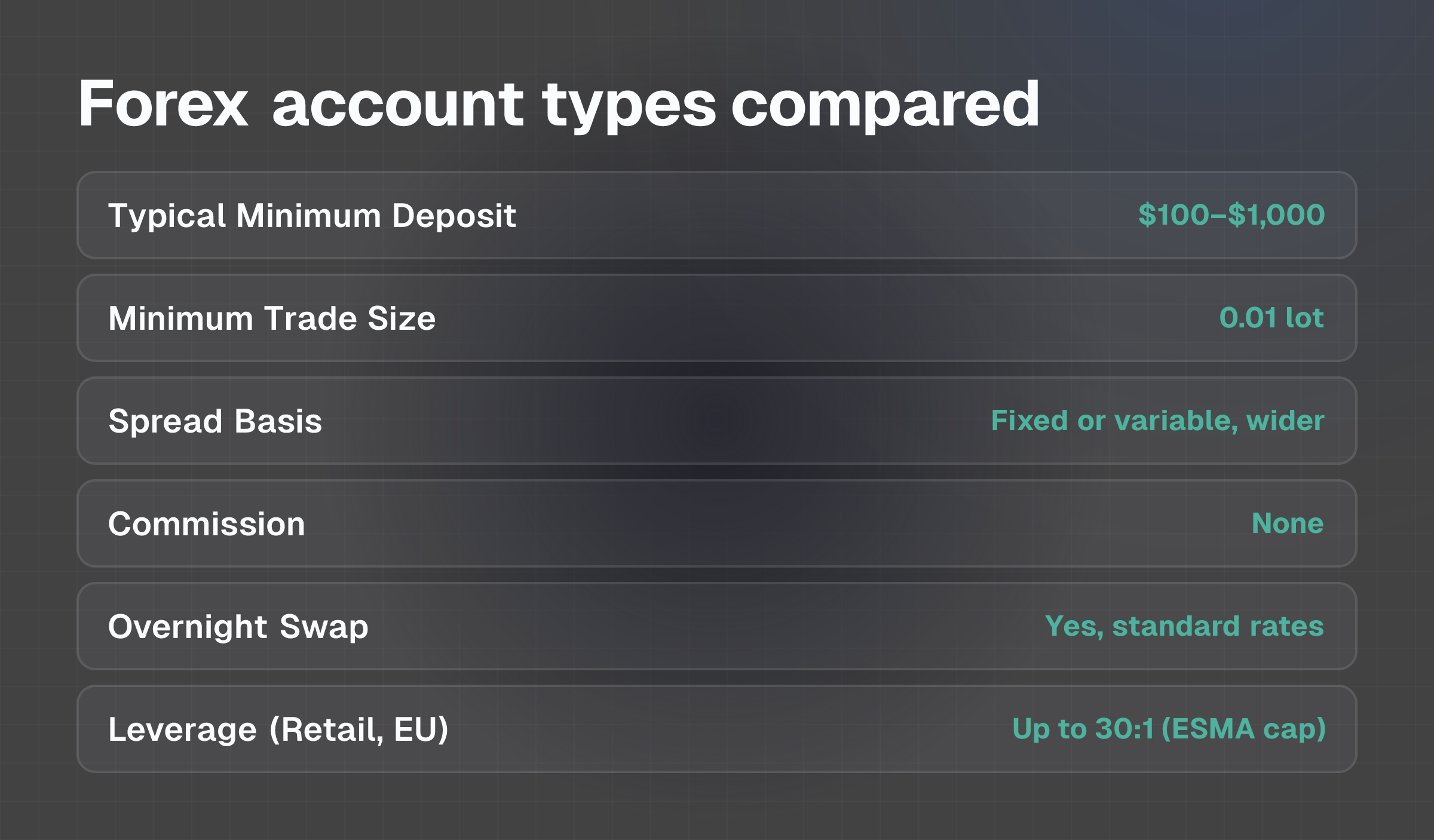
The following table compares the main types across key dimensions. This comparison is illustrative; actual terms vary by broker, jurisdiction, and regulatory entity. Always verify current terms with your chosen broker's official documentation.
| Feature | Standard Account | ECN Account | Micro Account | Professional Account | Islamic Account |
|---|---|---|---|---|---|
| Typical Minimum Deposit | $100, $1,000 | $2,500, $10,000 | $10, $100 | $5,000+ | Varies by broker |
| Minimum Trade Size | 0.01 lot | 0.1 lot (varies) | 0.01 lot | 0.1 lot (varies) | Often 0.01 lot |
| Spread Basis | Fixed or variable, wider | Raw, tighter | Variable, wider | Raw, tighter | Wider than standard |
| Commission | None | Yes (USD or pips per side) | None | Yes (tight spreads + commission) | None or admin fee |
| Overnight Swap | Yes, standard rates | Yes | Yes | Yes | No (or time-limited) |
| Leverage (Retail, EU) | Up to 30:1 (ESMA cap) | Up to 30:1 (ESMA cap) | Up to 30:1 (ESMA cap) | Higher (loses retail protections) | Up to 30:1 (ESMA cap) |
| Negative Balance Protection | Yes (EU retail) | Yes (EU retail) | Yes (EU retail) | No (professional status) | Yes (EU retail) |
| Best For | Beginners, simple spreads | Scalpers, high volume | Testing, low capital | Experienced, tight costs | Religious compliance |
| Avoid If | Scalp or high frequency | Low capital or low volume | Seeking advanced features | Need retail protections | Swap costs critical |
Key limitations and trade-offs
Spreads vs. commissions: Tight spreads on ECN accounts come with explicit commissions; on standard accounts, wider spreads include all costs.
Calculate total cost for your expected trade frequency and hold time before choosing.
Minimum deposit vs. leverage: Lower minimums on micro accounts often come with wider spreads and lower leverage (though still subject to regulatory caps). Higher minimums on ECN and professional accounts unlock tighter pricing but require more capital upfront.
Swap-free features: Islamic accounts remove overnight swap charges but typically impose wider spreads, administrative fees, or time limits (e.g., swap-free status expires after 90 days of inactivity). Verify exact terms.
Retail vs. professional status: Professional accounts offer higher leverage and tighter spreads but remove regulatory protections including negative balance protection and investor compensation in some jurisdictions.
This trade-off is irreversible in many cases; once you opt up, you can't easily revert to retail status.
Leverage and risk: Higher leverage amplifies both profits and losses. CFDs are complex instruments with a high risk of losing money rapidly due to leverage. Never view higher leverage as a benefit in itself; it reflects your ability to lose capital faster.
Execution model: Standard accounts involve the broker as counterparty (you trade against the broker's quotes). ECN accounts route you to external liquidity (you compete with other traders).
This affects slippage, fill rates, and how the broker profits; understanding this distinction is essential. Is Your Forex Broker the Counterparty? How to Check explains this in detail.
Which conditions fit each need
Use this framework to match account types to common trader profiles and situations.
Beginner trader, testing a strategy
Recommended starting point: Demo account, then micro account.
Why: Demo accounts cost nothing and let you learn platform mechanics without risk. Once confident, a micro account requires minimal capital ($10, $100) and features simple spread-only fees.
You avoid the complexity of commissions while maintaining real market conditions. Wide spreads on micro accounts matter less when testing; your focus is strategy validation, not profit.
Verify before opening: Platform compatibility (MetaTrader 4, MetaTrader 5, or proprietary platform) and withdrawal policies. Some brokers restrict or charge fees for micro account withdrawals.
Intermediate trader, consistent monthly volume
Recommended account type: Standard account or STP account.
Why: Standard accounts offer familiar spread-based pricing with no commission complexity.
STP accounts provide slightly tighter spreads than standard if you execute enough volume to justify the broker's routing costs. Minimum deposits ($100, $1,000) align with moderate capital, and leverage is sufficient for position and swing trading within regulatory caps.
Verify before opening: The exact spread on your most-traded currency pairs; ask for historical averages, not just minimums. Confirm swap rates if you hold positions overnight; these compound over time.
Scalper or high-frequency trader
Recommended account type: ECN account.
Why: Scalping profits from capturing small price movements; on a standard account with wide spreads, costs exceed the scalp itself.
ECN accounts offer raw spreads (often 0.0 or 0.1 pips on major pairs) plus per-trade commission. For high-volume scalping, this total cost is lower than wide spreads. Fast execution and direct market access matter for scalpers; slippage on standard accounts erodes edge quickly.
Verify before opening: Confirm the exact commission structure (USD per side? pips per round-trip?), contract size, and minimum lot size. Calculate total round-trip cost on your expected trade size before committing.
A Practical Guide to Comparing Brokerage Fees shows how to do this calculation.
Experienced trader meeting professional criteria
Recommended account type: Professional account (if eligible and protections don't matter to you).
Why: Professional accounts offer higher leverage (no EU cap), tighter spreads, and lower commissions on high-volume trading. You unlock better pricing because the broker faces fewer regulatory restrictions.
Critical caveat: Professional status removes retail protections, including negative balance protection and investor compensation schemes in many jurisdictions.
Once you forfeit these, reclaiming them is difficult or impossible. Only elect professional status if you fully understand the risks and have sufficient capital to absorb losses without relying on compensation schemes.
How to Check a Forex Broker's Licence and Spot Red Flags explains how to verify a broker's regulatory entity and what protections apply under its license.
Trader requiring swap-free accounts (religious compliance)
Recommended account type: Islamic or swap-free account.
Why: These accounts eliminate overnight swap charges, aligning with Sharia principles prohibiting interest.
Swap-free status doesn't mean fee-free; expect wider spreads, administrative fees per trade or per month, or time limits on swap-free eligibility.
Verify before opening: Exactly which instruments (currency pairs, commodities, indices) qualify as swap-free; many brokers exclude certain assets. Confirm whether swap-free status has a time limit or activity threshold.
Understand the exact cost structure, if the broker charges $2 per 0.1 lot per month or widens spreads by 2 pips, calculate whether that's cheaper than standard swap rates for your strategy.
Trader with very limited capital or learning focus
Recommended account type: Micro account.
Why: Micro accounts accept deposits under $100 and allow trade sizes as small as 0.01 lot.
Spreads are wider than standard accounts, but capital risk is limited. This is ideal for testing strategies or learning risk management without exposure to large losses.
Avoid if: You plan to scalp or execute high-frequency strategies; wide spreads will consume profits. If you later graduate to high-volume trading, the micro account's limitations may frustrate you; some traders prefer to start on a standard account to avoid relearning on a different platform.
Choose an account type after assessing your capital, experience, strategy, and regulatory location.
Your broker should clearly publish account terms, minimum deposits, fee structures, and leverage limits before you fund. Verify these in writing and ensure the account type you select remains compatible with your expected holding periods and trade frequency.
Choosing Your First Broker: What Beginners Need to Know and How to Choose an Online Broker: A 2026 Guide offer broader frameworks for broker selection once you've narrowed your account type.