Choosing Your First Broker: What Beginners Need to Know

Choosing an online broker as a new investor means balancing ease of use, cost, safety, and learning support. A brokerage firm executes buy and sell orders on your behalf and provides access to markets like stocks, ETFs, and mutual funds through a trading platform. This guide walks you through the core criteria that matter most for beginners, regulatory status, platform simplicity, transparent fees, educational resources, and customer support, so you can use comparison tools to shortlist accounts that fit your specific investment goals and risk tolerance.
Last verified: November 12, 2026
Eligible accounts at a glance: What beginners should look for
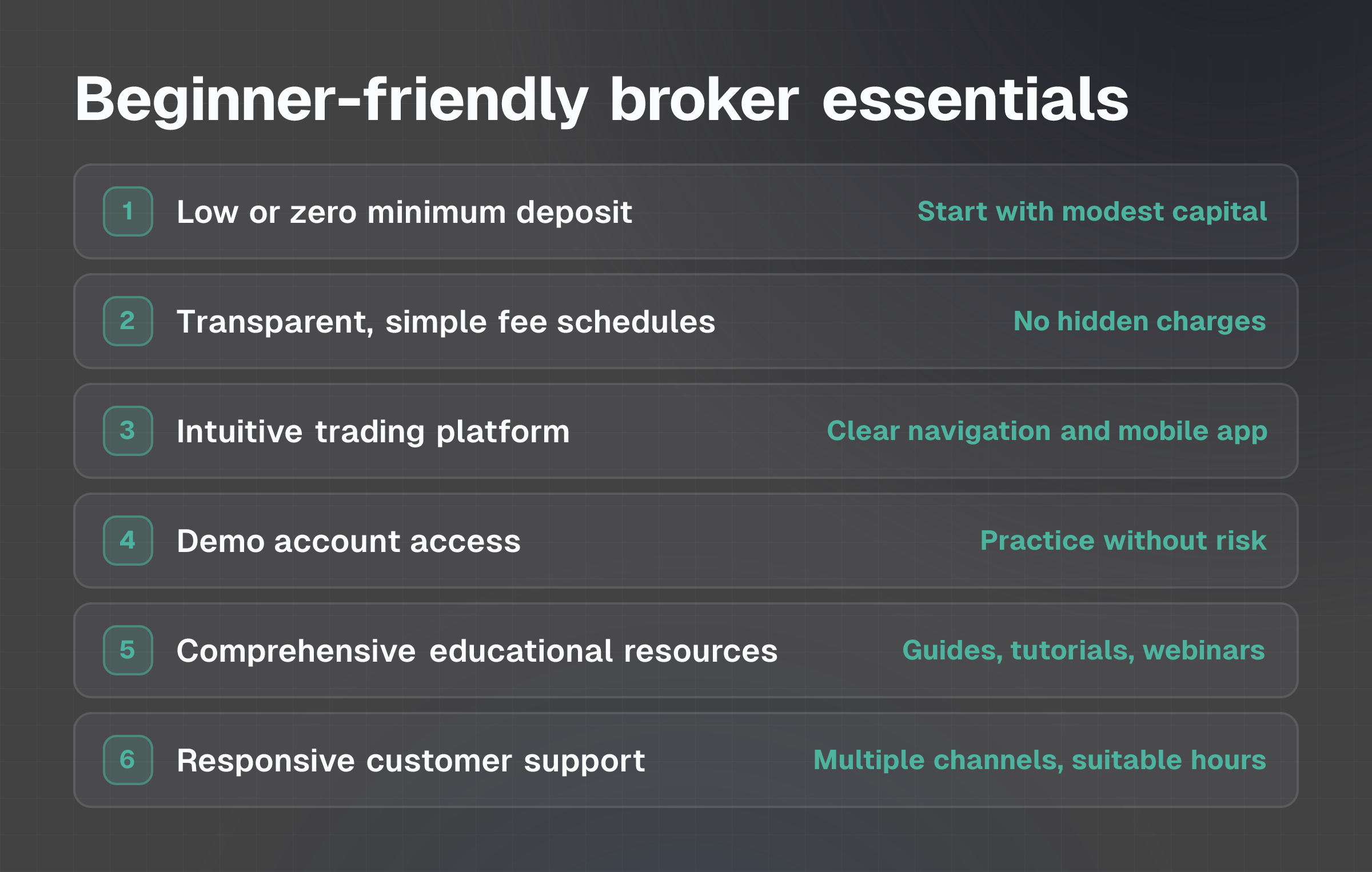
A beginner-friendly brokerage account typically offers:
- Low or zero minimum deposit to start investing with modest capital
- Transparent, simple fee schedules with no hidden inactivity, withdrawal, or maintenance charges
- Intuitive trading platform with clear navigation, simple order placement, and mobile app availability
- Demo account access to practice trading without risking real money
- Comprehensive educational resources including guides, tutorials, webinars, and articles on fundamental investing concepts
- Responsive customer support via multiple channels (phone, email, live chat) during hours suitable for your timezone
- Regulation by a reputable financial authority in the broker's primary operating jurisdiction
Regulatory bodies such as the Securities and Exchange Commission (SEC) in the US, the Financial Conduct Authority (FCA) in the UK, ASIC in Australia, and CySEC in Cyprus oversee financial markets and protect investors through licensing and oversight. A regulated broker offers a layer of protection; you should verify the broker's license and registration status by checking the regulator's public register.
Beginners should also avoid complex, leveraged products such as CFDs or options. Leveraged products carry a high risk of losing money rapidly due to leverage and aren't suitable for all investors; the WhatBroker research desk consistently notes that these instruments pose significant risk to new traders who lack sufficient understanding.
Selection criteria and date: How to evaluate a broker fit for your needs
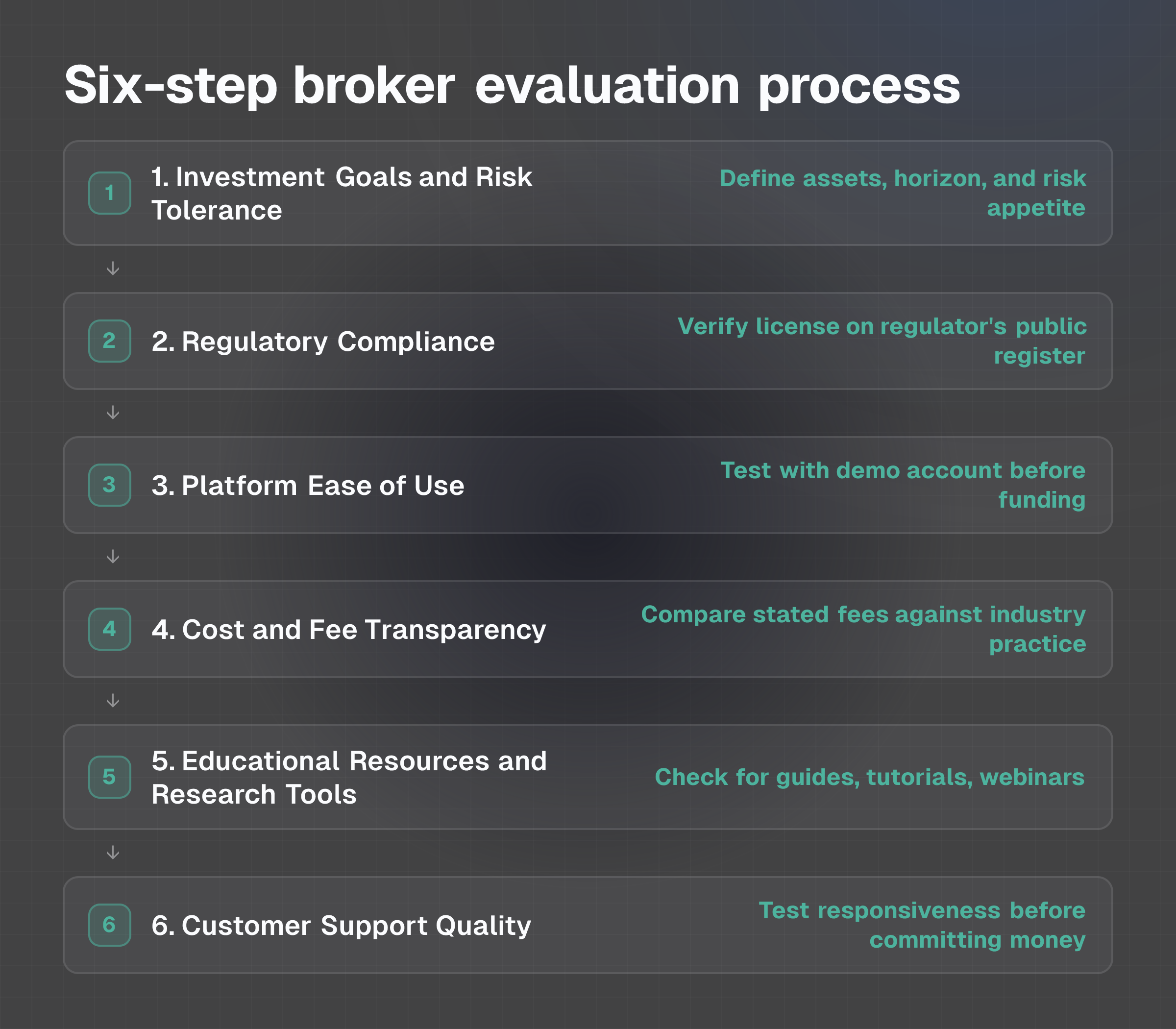
Define your own investment context before comparing accounts.
1. Investment Goals and Risk Tolerance
What assets do you want to trade, stocks, ETFs, mutual funds? What's your investment horizon? How much risk can you stomach? Your answers shape which broker features and account types suit you. Simple questions, but they determine everything that follows.
2. Regulatory Compliance
The broker must be regulated by a reputable financial authority. Check the regulator's public register to confirm the broker's license and registration status. Avoid unregulated brokers; trading with them carries significant risk, including lack of investor protection, potential for fraud, and difficulty in dispute resolution.
3. Platform Ease of Use
Look for an intuitive interface, clear navigation, and simple order placement. For beginners, a clean design with essential functionalities beats complex charting tools. Test the platform by using a demo account before funding a live account; this helps you become familiar with the trading environment and reduces errors.
4. Cost and Fee Transparency
Compare the stated fee schedule against typical industry practice. Look for low or zero commissions on frequently traded assets like US stocks and ETFs. Watch for hidden fees, inactivity charges, withdrawal costs, currency conversion markups, account maintenance levies. Clear disclosure of all charges upfront is non-negotiable.
For minimum deposits, prioritize brokers with no minimum or very low minimums (under $100) if starting with limited capital is a priority.
Forex Trading Costs Explained: Compare More Than the Spread provides deeper context on how spreads, commissions, and financing charges combine to affect your total cost of trading.
5. Educational Resources and Research Tools
Availability of guides, tutorials, webinars, articles, and market analysis relevant to beginners is essential. Prioritize brokers offering comprehensive learning centers and practical 'how-to' guides for fundamental concepts. These resources help you make informed decisions rather than relying on unsubstantiated tips.
6. Customer Support Quality
Multiple contact channels (phone, email, chat), responsiveness, and availability (24/5 or 24/7) matter. Consider reading independent reviews regarding customer service experiences before opening an account. Test support yourself by asking a question before you commit any money; response time and clarity tell you what you're getting into.
Account comparisons and limitations: Key trade-offs for new investors
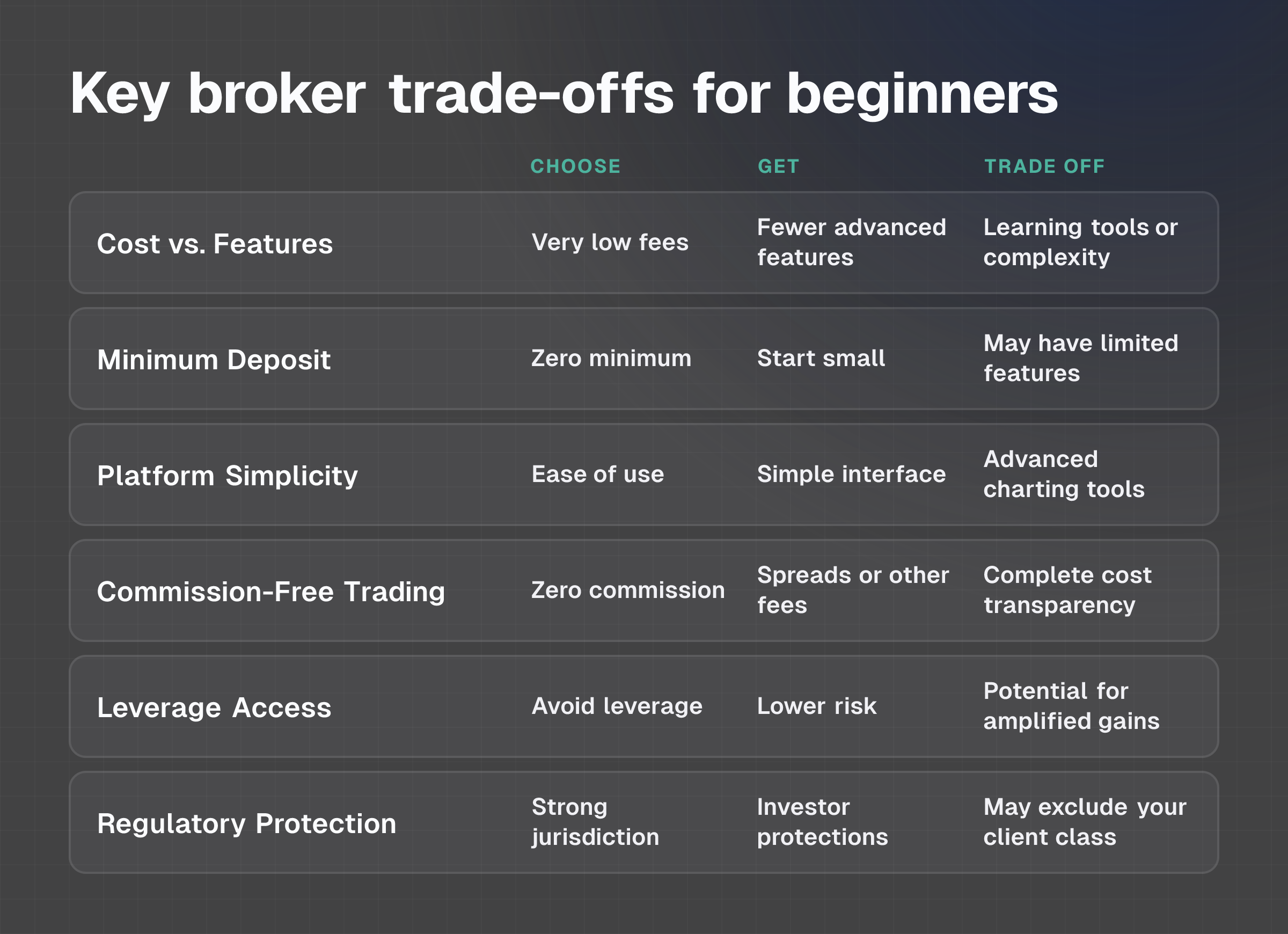
Understand these important trade-offs and limitations when comparing beginner-focused broker accounts.
Cost vs. Features
Brokers with very low fees might offer fewer advanced features or less extensive educational resources. High-feature brokers may have higher costs or be too complex for a beginner. Your choice depends on whether you prioritize cost savings or comprehensive learning tools.
Minimum Deposit vs. Starting Capital
A zero or very low minimum deposit lets you start small, but it may also indicate limited account features or higher per-trade costs. A higher minimum deposit often unlocks better terms but requires more upfront capital.
Platform Simplicity vs. Advanced Tools
Beginner platforms prioritize ease of use over advanced charting, algorithmic trading, or professional research tools. If you need sophisticated analysis features later, you may outgrow the initial platform. That's fine. Start simple.
Commission-Free Trading vs. Hidden Costs
"Commission-free" trading on stocks and ETFs often means the broker earns revenue through spreads (the difference between bid and ask prices), financing charges, or other fees. Review the complete fee structure, not just commission rates. Zero commission doesn't equal zero cost.
Leverage and Risk
Some brokers advertise high leverage ratios as a benefit; beginners should avoid this. Leveraged products carry a high risk of losing money rapidly and aren't suitable for all investors. Focus on account types that restrict or eliminate leverage.
Regulatory Protection Scope
Regulation varies by jurisdiction. A broker regulated in one country may not offer the same protections to clients in another. Verify that the regulator covers your account type and client class; group-level licenses don't cover every individual service or account.
Is Your Forex Broker the Counterparty? How to Check explains how to verify the regulatory structure and operational model of your chosen broker.
Which conditions fit each need: Matching broker features to your priorities
If you prioritize learning and education over advanced features:
Choose a broker with extensive educational resources, a demo account, and straightforward platform design. Seek brokers offering webinars, video tutorials, and beginner-focused articles on fundamental investing concepts. Customer support responsiveness matters here; you'll benefit from quick answers to basic questions.
If you want to start with minimal capital:
Prioritize brokers with no minimum deposit or minimums under $100. Verify that low minimums don't come with hidden fees, such as inactivity charges if your account sits unused for 30 or 60 days. Read the full fee schedule before opening an account. Fine print matters.
If you plan to trade frequently:
Compare commissions and spreads carefully. Forex Trading Costs Explained: Compare More Than the Spread details how spreads, commissions, and financing interact. Frequent traders benefit from zero-commission stocks and ETFs, but should still calculate total cost including spreads and any other per-trade charges.
If you need reliable customer support:
Choose brokers with 24/5 or 24/7 support, multiple contact channels, and positive independent reviews of response times. Test support by asking a question before opening an account; this reveals responsiveness without financial commitment.
If you want to avoid complex or leveraged products:
Select brokers whose account types default to non-leveraged instruments, stocks, ETFs, mutual funds, and either exclude or prominently warn against CFDs, options, and margin trading. Some brokers offer "swap-free" or Islamic accounts; verify that these don't carry additional administrative fees and understand any instrument exclusions.
If safety and regulation are your top concern:
Verify that the broker is regulated by an established authority (SEC, FCA, ASIC, CySEC) in a jurisdiction with strong investor protections. Check the regulator's public register, confirm the license status, and understand what protections apply to your account type and client class. Avoid brokers with opaque ownership structures or offshore routing.
Use WhatBroker's comparison tools to filter accounts by minimum deposit, regulation, platform type, and fee structure. The broker directory provides detailed profiles of regulated firms; How WhatBroker ranks and discloses explains the methodology behind each listing.
Common mistakes to avoid: ignoring fees and hidden charges, skipping the demo account, trading complex instruments without sufficient understanding, and making investment decisions based on unsubstantiated tips rather than fundamental research and personal financial goals.