Is Your Forex Broker the Counterparty? How to Check

When you open a forex trading account, the entity legally bound to the opposite side of your trade, your contractual counterparty, shapes your execution experience, costs, and the broker's financial incentive structure. Your broker might act as the counterparty directly, or they might route your orders to banks and liquidity providers.
These are two distinct contractual positions. They're not always clear from marketing alone.
This guide walks you through a short verification sequence using official documents and regulatory records to identify which model applies to your account, what that means in practice, and when to escalate your question.
What to identify first: Locating your broker's execution model
Start by finding the broker's official Execution Policy (also called Order Execution Policy or Best Execution Policy) and Client Agreement (or Terms of Business). Regulated brokers must publish these documents. Look in the legal or compliance section of their website, often linked from the footer or under a "Documents" or "Legal" heading.
These two documents serve different purposes. The Client Agreement establishes the legal identity of the counterparty and the terms of your trading relationship with the broker. The Execution Policy describes how the broker processes orders, sources prices, and handles your trades to meet regulatory best execution obligations.
You need both to understand the full picture.
If you can't locate either on the broker's website, note this as a gap in the available information, this article doesn't cover brokers whose official documents aren't publicly available online.
Verification steps: Reading the agreements for contractual role and order handling
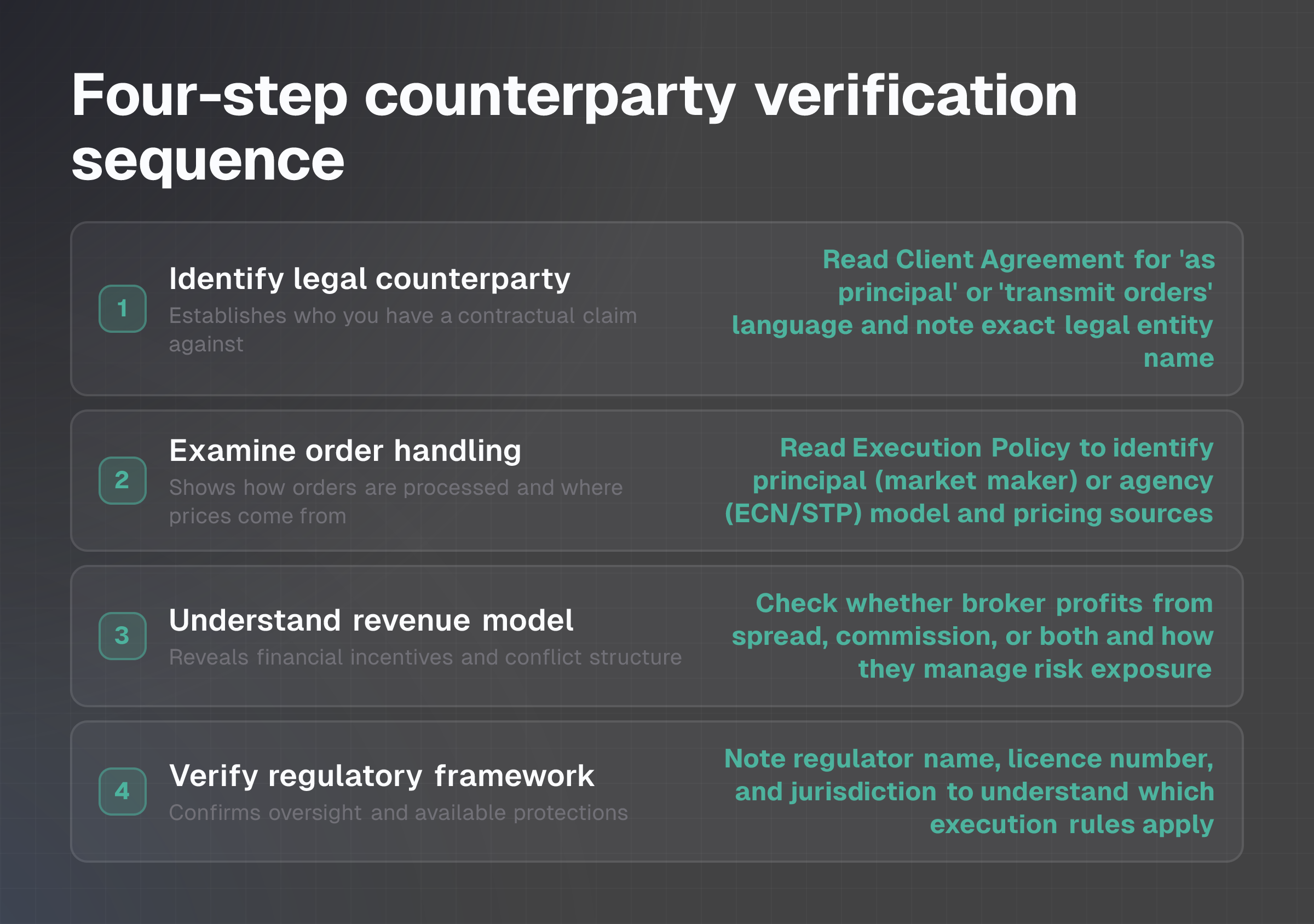
Step 1: Identify the legal counterparty in the Client Agreement
Open the Client Agreement and search for explicit statements about who you trade with. Look for language like:
- "You enter into trades with [Broker Name] as principal" or "We act as counterparty to all transactions you enter into with us."
- Alternatively, language indicating an agency relationship: "We transmit your orders to third-party liquidity providers who become the counterparty to your trade."
Note the exact legal entity name and its governing jurisdiction. This is the entity you have a contractual claim against in case of dispute.
Example: ABC Broker UK Ltd's Client Agreement (Section 4.1, effective 15 September 2023) states: "When you open an account with ABC Broker UK Ltd, you appoint us to act as your principal in relation to all Transactions executed through your Account. This means that we are the counterparty to all Transactions you enter into with us."
This statement establishes ABC Broker UK Ltd as the legal counterparty, regardless of how they manage their own risk.
Step 2: Examine the Execution Policy for order handling and pricing
Open the Execution Policy and identify which of these broad models the broker describes:
Principal (Market Maker) Model:
The broker states it executes orders as principal, quoting its own prices. Prices are sourced from proprietary feeds or internal pricing, often based on interbank data but adjusted by the broker. The broker holds positions against your trades and profits from the spread, the difference between bid and ask prices.
The broker may hedge its own exposure by dealing with external liquidity providers. This hedging doesn't change your contractual counterparty. It remains the broker.
Agency (ECN/STP) Model:
The broker states it transmits orders to external liquidity providers (LPs), banks, ECNs, or other brokers. The external liquidity provider becomes the counterparty to your trade. Prices are aggregated from multiple external sources or passed through directly from an LP without broker markup on the raw spread. The broker's revenue comes from commission per trade or a markup added to the spread.
Critical distinction: ECN and STP labels describe how orders are handled and how prices are sourced. They don't automatically change the legal counterparty. A broker can use ECN or STP order routing to hedge its exposure while remaining your legal counterparty. Always verify the contractual statement in the Client Agreement, not the marketing label alone.
Step 3: Understand the broker's revenue model in context
The Execution Policy may describe the broker's financial incentives.
For principal brokers, revenue comes primarily from the spread and from managing the risk associated with positions held against your trades. If client trading creates an imbalance, for example, more clients buy than sell a currency pair, the broker holds an exposure to that imbalance. To manage this risk, they may hedge by taking offsetting positions with external liquidity providers.
A principal broker profits from spreads. But their long-term financial incentive is to maintain high client activity and a stable, diversified client base. Consistent client losses leading to account closures aren't sustainable. Their risk management is designed to balance profitability with stability, not to ensure client losses. The conflict lies in execution decisions, requotes, slippage, order rejection, where the broker's pricing and hedging decisions can affect your fill quality, not in a simple win-lose relationship.
For agency brokers, revenue comes from commission or spreads charged per trade. The broker aims for a matched book where they don't hold significant directional risk against clients. The broker's exposure is minimal because they pass on trades to external liquidity providers.
Step 4: Verify regulatory disclosures
Identify the regulator and jurisdiction governing the broker. Search the Client Agreement and Execution Policy for a statement like:
"[Broker Name] is authorised and regulated by [Regulator Name] under licence number [FRN/Reference]."
Note the regulator's name and jurisdiction. This tells you which regulatory framework applies to the execution obligations the broker describes in their Execution Policy. For example:
- EU and UK brokers must comply with MiFID II best execution rules.
- Australian brokers must comply with ASIC requirements.
- US brokers dealing with retail clients must comply with NFA/CFTC rules.
Don't assume that a group-level licence covers every account or every trading product. Bind the regulation and client protections to the specific contracting entity, the service (forex, CFDs, etc.), your residence, and your client classification (retail, professional, or eligible counterparty).
Interpret the result: What the verification establishes and does not establish
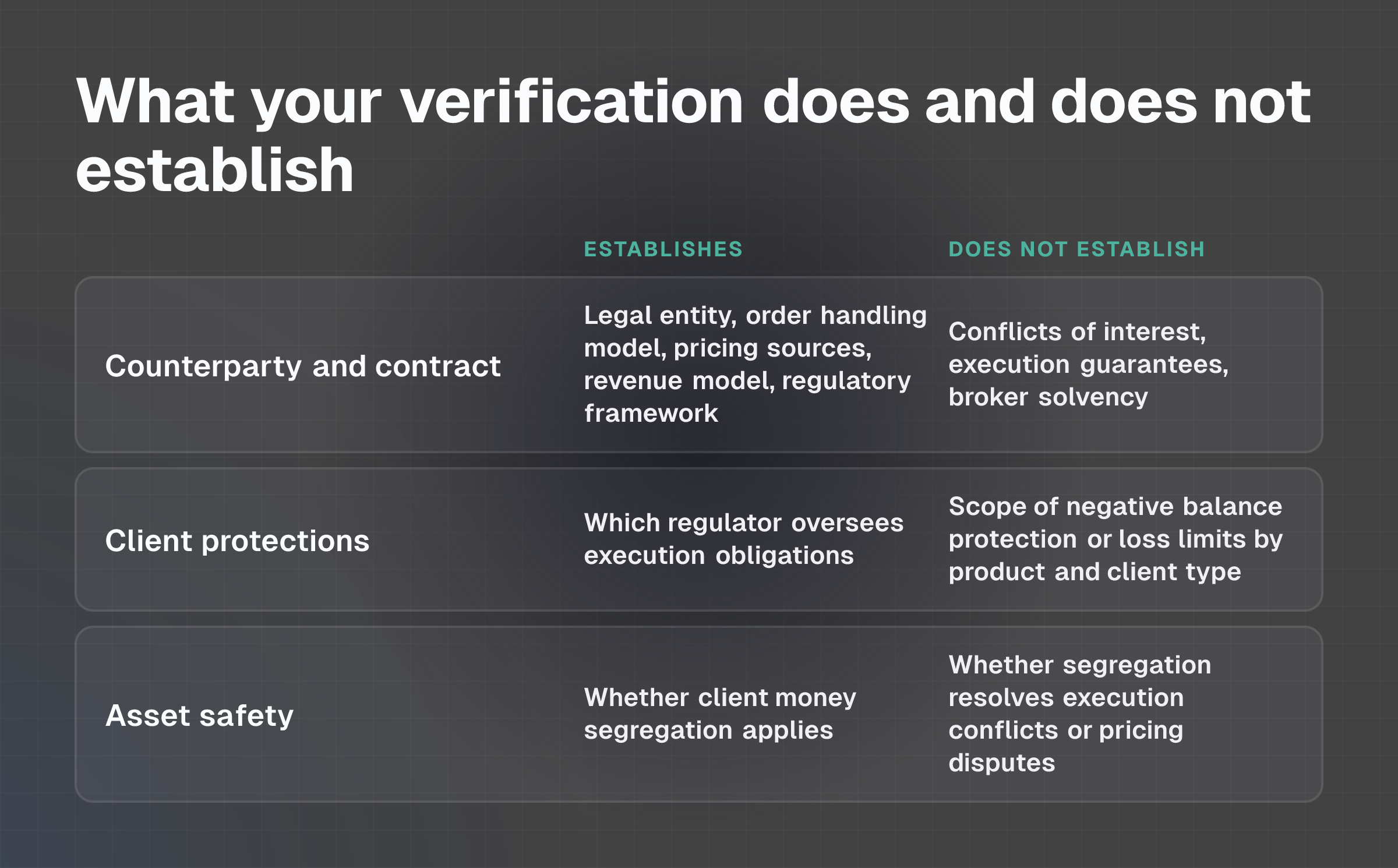
What your verification establishes
After reading the Client Agreement and Execution Policy, you'll have identified:
- The legal counterparty: The exact entity you have a contractual relationship with when you trade.
- The order handling model: Whether your broker executes as principal or routes to external LPs.
- Pricing sources: Whether prices are proprietary, aggregated, or passed through from an external source.
- The broker's revenue model: How the broker profits from your trading activity (spread, commission, or both).
- Regulatory framework: Which regulator oversees the broker's execution obligations.
What your verification does NOT establish
Your verification does not:
Resolve potential conflicts of interest related to execution or pricing. Client money segregation, holding your funds in separate accounts from the broker's operational funds, is a crucial safeguard for asset protection in case of broker insolvency. It does not address or resolve conflicts of interest between you and the broker regarding trade execution or pricing decisions. Segregation is a balance-sheet protection, not a conflict-of-interest resolution.
Guarantee best execution across all market conditions. The Execution Policy describes the broker's policy, not a performance guarantee. Market volatility, liquidity constraints, or technical factors may prevent the stated policy from delivering the best price on every trade.
Establish the stability or solvency of the broker. A broker's execution model and contractual role tell you who you trade with and how they profit, not whether the broker is financially stable or will remain in business.
Clarify product-specific risks or protections. Loss-beyond-deposit protections (such as negative balance protection) vary by entity, product, jurisdiction, and client classification. A statement in the Client Agreement about negative balance protection may apply only to certain products (e.g., CFDs) or client types (e.g., retail clients). Always verify the exact scope by product and client class before relying on this protection.
When to stop and escalate
Stop your verification and contact the broker or a financial adviser if:
- You can't locate a Client Agreement or Execution Policy on the broker's website after a thorough search of the legal and compliance sections.
- The documents you find are contradictory or unclear about the identity of the counterparty or the execution model.
- You need clarification on how a specific protection (such as negative balance protection) applies to your account, product, and residence.
- You're unsure whether the regulatory framework disclosed in the documents applies to you, given your residence and client classification.
- You have a dispute with the broker over execution or pricing and need to understand your contractual rights and available remedies.
What to save or ask next: Documentation and follow-up steps
Save these documents
Download and retain copies of:
- Client Agreement (or Terms of Business / Customer Trading Agreement), note the version number and effective date.
- Execution Policy (or Order Execution Policy / Best Execution Policy), note the version number and effective date.
- Regulator confirmation (if available), a screenshot or printout of the broker's licence from the regulator's official register.
These documents are your evidence of the contractual terms, execution model, and regulatory status at the time you open your account. If terms change, the broker must provide updated documents and often must give you the right to accept or reject the new terms.
Questions to ask the broker
If the documents don't clearly answer any of the following, send a written inquiry to the broker's support or compliance team:
- "What is the legal name and jurisdiction of the entity I trade with as counterparty?"
- "How do you handle my orders? Do you execute as principal, or do you route to external liquidity providers?"
- "Where do the prices I see come from, proprietary pricing, aggregated feeds, or direct from a liquidity provider?"
- "How does negative balance protection (or any other loss protection) apply to my specific account type, product, and residence?"
- "If I dispute a trade execution, which regulatory body should I approach, and what is your internal complaints process?"
Request written responses so you have evidence of the broker's statements.
Next verification steps
Once you understand your broker's execution model and contractual role, you may want to verify other aspects of your trading relationship:
- Forex Trading Costs Explained: Compare More Than the Spread walks through how to compare total costs across different execution models and commission structures.
- How to Choose a Forex Broker: Costs, Rules and Platforms provides a decision framework for comparing brokers based on regulation, costs, and execution.
- Broker directory and Broker reviews offer comparisons of verified brokers and their stated execution models.
Last verified: November 11, 2026