A Practical Guide to Comparing Brokerage Fees

Most traders compare brokers by spread alone and miss half the cost picture. A 0.5 pip spread looks attractive until you add the $7 per-lot commission, the negative swap on overnight holds, and the $10 withdrawal fee. The "all-in cost", the sum of every trading and non-trading fee that touches your account, is the only number worth comparing. This guide walks through a complete calculation so you can see what you'll actually pay each month, not what the headline figure promises.
Last verified: November 14, 2026
Direct answer and key distinction: Why spread is not the full story
A broker quoting a 0.5 pip spread on EUR/USD hasn't told you your cost per trade. That's just the bid-ask difference. It excludes the commission charged per lot, the swap cost on positions held overnight, and the fees levied on withdrawals or inactive accounts.
Two brokers with identical spreads can produce wildly different monthly bills depending on how often you trade, how long you hold positions, and which non-trading fees hit your account. A swing trader holding positions for days accumulates swap charges a scalper never sees. Someone making 50 round-turn trades monthly feels commission structures far more than a trader executing twice a week. The all-in cost is the sum of every fee relevant to your frequency, hold duration, and funding habits. Compare that single figure across brokers, not spreads, commissions, or swaps in isolation, and the true cost hierarchy reveals itself.
How the cost or condition works: The five components of total broker cost
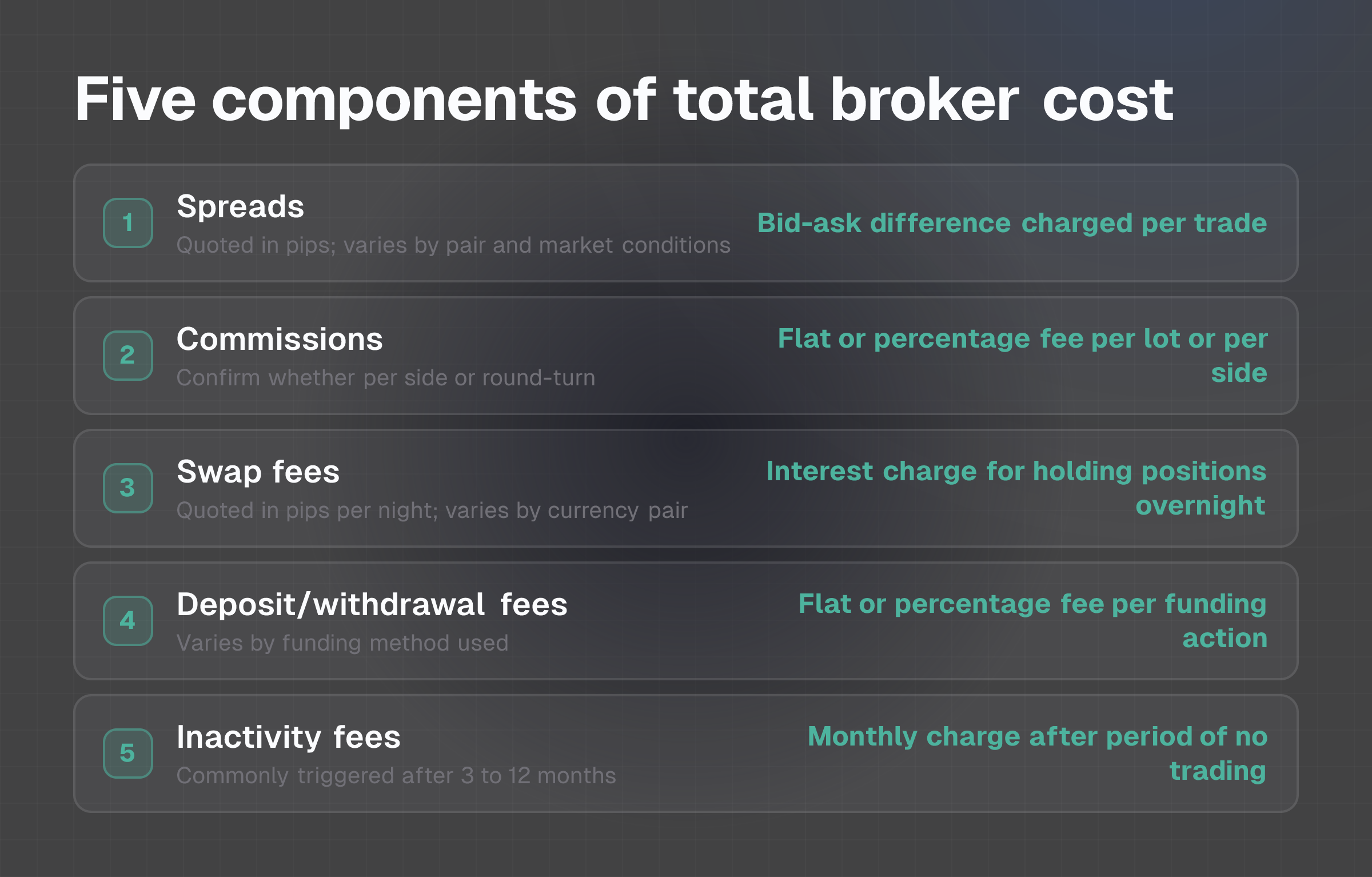
Forex broker costs split into two buckets: trading fees charged per transaction and non-trading fees charged for account maintenance or servicing.
Trading fees: Per-transaction costs
Spreads are the gap between the bid price (where you sell) and the ask price (where you buy). A 0.5 pip spread on EUR/USD means the bid-ask difference is 0.5 pips. Spreads are quoted in pips and vary by currency pair and market conditions.
Some brokers offer fixed spreads that hold steady during volatile periods. Others offer variable spreads that tighten during peak liquidity and widen when markets thin out. To convert a spread into dollar cost per standard lot, multiply the pip spread by the pip value for that lot size, typically $10 per pip for a standard lot on major pairs.
Commissions are flat or percentage-based fees charged per trade. A broker might charge $7 per standard lot on a round-turn trade (entry and exit combined) or per side (entry only, or exit only). Commission structures differ widely: some brokers charge per lot, others per side, still others use a percentage of notional value.
Always confirm whether the quoted commission is per side or round-trip, and in which currency.
Swap fees (also called overnight financing or rollover fees) are interest charges or credits applied when you hold a position past the daily settlement time, typically 5 p.m. U.S. Eastern Time. The swap reflects the interest rate differential between the two currencies in the pair. If you hold a long EUR/USD position overnight, the swap may be negative (you pay), reflecting the interest rate gap.
Swaps are quoted in pips per night and vary by broker and currency pair. To calculate total swap cost, multiply the nightly pip charge by the pip value, then multiply by the number of nights held.
Slippage is the gap between the price at which you expected to enter or exit and the price at which you actually executed. While not a direct fee, slippage cuts into your effective profit on each trade and accumulates across high-volume trading. Slippage is greatest during volatile periods or when liquidity thins.
Non-trading fees: Account-level charges
Deposit and withdrawal fees are charged by the broker for funding or withdrawing from your account. Some brokers charge a flat fee per withdrawal, $10, for example. Others charge a percentage of the amount withdrawn.
Funding methods vary in cost: bank wire transfers may incur a fee, while credit card deposits typically don't but may carry a percentage charge. See Forex Broker Deposits and Withdrawals: Fees, Times and Checks for a detailed comparison of funding options.
Inactivity fees are charged if your account has no trading activity for a set period, commonly 3 to 12 months. A broker might charge $15 per month if no trades are made during that window. For active traders, inactivity fees are irrelevant. For those who trade sporadically or seasonally, they can accumulate quietly.
Account maintenance fees are regular charges simply for holding an account, regardless of activity. These are less common in forex than inactivity fees but worth checking.
Currency conversion fees apply when you deposit or withdraw funds in a currency different from your account's base currency. If your account is denominated in USD but you deposit in EUR, the broker may charge a percentage, commonly 1 to 3%, to convert the funds.
One worked example or checklist: Calculating all-in cost for a swing trader
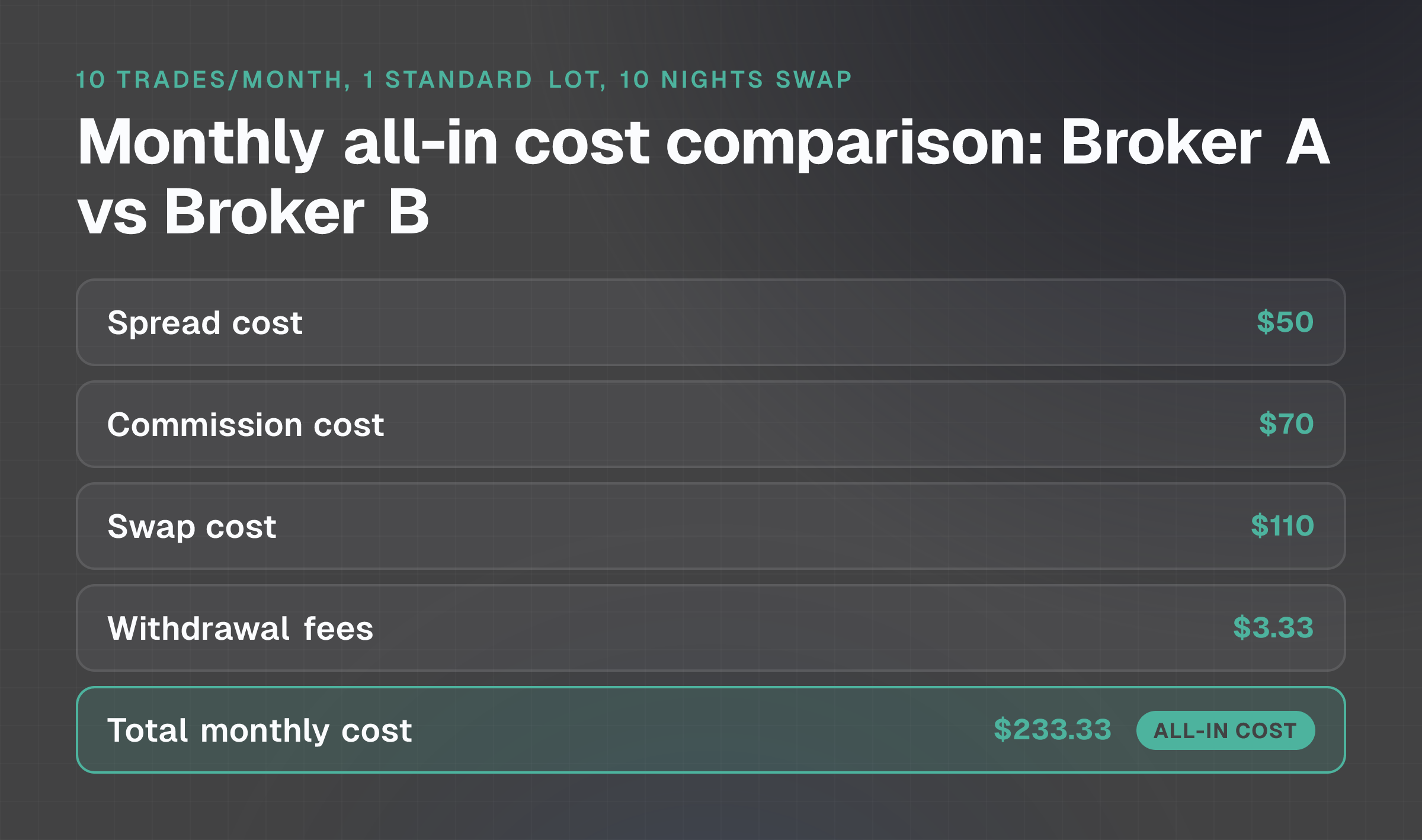
The following example shows how to compute total monthly cost across two brokers with different fee structures. Use this framework to evaluate your own broker choices.
Scenario setup
You're a swing trader focusing on EUR/USD. Your profile:
- 10 round-turn trades per month, each 1 standard lot.
- Overnight holds: 50% of trades (5 trades) held overnight, average 2 nights each = 10 total nights of swap charges.
- Overnight mix: 5 long positions and 5 short positions (for swap calculation).
- Deposit: $5,000 initial.
- Withdrawals: 1 per quarter ($30 total per year, or $2.50 per month average).
- Account status: Active (inactivity fees don't apply).
Broker A: Commission-based structure
- Spread (EUR/USD): 0.5 pips average.
- Commission: $7 per standard lot, round-turn.
- Swap (EUR/USD long): , 0.8 pips per night (you pay).
- Swap (EUR/USD short): , 0.3 pips per night (you pay).
- Withdrawal fee: $10 per withdrawal.
- Inactivity fee: None (account is active).
- No other fees.
Broker B: Spread-based structure
- Spread (EUR/USD): 1.5 pips average.
- Commission: None.
- Swap (EUR/USD long): , 0.7 pips per night (you pay).
- Swap (EUR/USD short): , 0.2 pips per night (you pay).
- Withdrawal fee: None.
- Inactivity fee: None.
- No other fees.
Monthly cost calculation
Step 1: Spread cost
Spread cost = Pip spread × Number of trades × Pip value per standard lot.
- Broker A: 0.5 pips × 10 trades × $10/pip = $50.
- Broker B: 1.5 pips × 10 trades × $10/pip = $150.
Step 2: Commission cost
- Broker A: $7/lot × 10 lots = $70.
- Broker B: $0 = $0.
Step 3: Swap cost
Swap cost = (Pips per night × Nights held × Pip value) for each position type, summed.
-
Broker A:
- Long: 0.8 pips/night × 2 nights × 5 positions × $10/pip = $80.
- Short: 0.3 pips/night × 2 nights × 5 positions × $10/pip = $30.
- Total: $110.
-
Broker B:
- Long: 0.7 pips/night × 2 nights × 5 positions × $10/pip = $70.
- Short: 0.2 pips/night × 2 nights × 5 positions × $10/pip = $20.
- Total: $90.
Step 4: Non-trading fees (monthly average)
- Broker A: $10/withdrawal × 4 quarters ÷ 12 months = $3.33/month.
- Broker B: $0.
Step 5: Total monthly all-in cost
- Broker A: $50 (spread) + $70 (commission) + $110 (swap) + $3.33 (withdrawal) = $233.33.
- Broker B: $150 (spread) + $0 (commission) + $90 (swap) + $0 (withdrawal) = $240.
In this example, Broker A is cheaper despite its commission structure. The tighter spread and slightly higher swap cost on short positions don't offset the $100 spread penalty at Broker B.
Checklist for your own calculation
To apply this method to your trading:
1. Define your trading profile:
- How many trades per month do you make?
- What's your typical lot size: micro, mini, standard?
- What percentage of trades do you hold overnight?
- How many nights, on average, do you hold each overnight position?
- How many times per year do you withdraw funds?
2. Gather broker fee data:
- Average spread on your preferred currency pair during your typical trading hours.
- Commission structure: per lot, per side, or round-trip? In which currency?
- Swap rates for long and short positions on your currency pair.
- Deposit/withdrawal fees and methods you use.
- Inactivity fee threshold and monthly charge (if any).
- Currency conversion fees (if applicable).
3. Calculate trading costs:
- Spread cost = (Spread in pips) × (Number of trades) × (Pip value for your lot size).
- Commission cost = (Commission per trade) × (Number of trades).
- Swap cost = (Pips/night) × (Nights held per position) × (Number of overnight positions) × (Pip value), summed for long and short.
4. Calculate non-trading costs:
- Withdrawals: (Withdrawal fee) × (Withdrawals per year) ÷ 12.
- Inactivity: (Monthly fee if triggered) or $0 if you trade regularly.
- Conversion: (Percentage of deposits/withdrawals) × (Annual funding volume) ÷ 12.
5. Sum for total monthly cost:
All-in cost = Trading costs + Non-trading costs.
6. Compare across brokers:
Plug your trading profile into each broker's fee schedule. Calculate the all-in cost for each. The broker with the lowest all-in cost is the most cost-efficient for your specific style.
Checks before choosing an account: Verification steps for fees and regulation
Before opening an account, verify that the broker's fee schedule matches your trading profile and that the broker is regulated by a credible authority.
Regulatory compliance
Choose a broker regulated by a recognized financial authority in your country of residence. The Australian Securities and Investments Commission (ASIC) imposes specific requirements on brokers operating in Australia. The Financial Conduct Authority (FCA) in the United Kingdom does the same for its regulated entities.
Regulatory oversight doesn't guarantee low fees, but it ensures a legal framework for dispute resolution and client asset protection.
Account eligibility and minimums
Confirm you meet the broker's eligibility criteria before applying. Most brokers require a minimum deposit, commonly $100 to $5,000, completion of Know Your Customer (KYC) verification, and residence in an approved jurisdiction.
Some brokers offer multiple account tiers with different fee structures. Verify that the account you're comparing includes the fees and spreads you've noted.
Fee schedule verification
Locate the broker's official fee schedule on its website, typically under "Pricing," "Trading Conditions," or "Fee Schedule." Cross-check:
- Spreads: Confirm the spread is an average or typical range, not a minimum. Note whether spreads are fixed or variable and any widening during off-peak hours.
- Commissions: Verify the commission is per lot, per side, or round-turn, and confirm the currency.
- Swaps: Check that swap rates are updated regularly, many brokers update monthly based on interest rate changes.
- Deposit/withdrawal fees: Note the flat fee or percentage, and any minimum amounts.
- Inactivity threshold: Confirm the number of months of inactivity that trigger the fee.
Platform and tool compatibility
Verify your broker supports the trading platform you intend to use. MT4 and MT5 are the most common. Confirm availability at your chosen broker.
See Trading Platform Compatibility: Check Your Broker Account for detailed checks on platform support.
Slippage and execution quality
Execution slippage, while not explicitly listed as a fee, can significantly impact your overall costs. Some brokers provide average slippage statistics or execution speed metrics on their websites. If these are available, be sure to request them, or review the broker's execution policy to determine if they operate as a market maker or an ECN/STP broker.
Market makers may apply wider slippage. ECN brokers typically show tighter execution but charge commissions.
Step-by-step verification checklist
- Broker is regulated by ASIC, FCA, or equivalent authority in your jurisdiction.
- I meet the minimum deposit and KYC requirements.
- I've located the broker's official fee schedule and noted all fees relevant to my trading profile.
- Spreads are stated as typical or average, not minimum, and I understand whether they're fixed or variable.
- Commission structure is clear (per lot, per side, round-trip) and in a currency I can convert.
- Swap rates are available for the currency pairs I trade, and I understand the overnight calculation.
- Deposit and withdrawal methods I use are listed with their fees.
- Inactivity fee threshold is documented (if any).
- The broker supports my preferred trading platform (MT4, MT5, or other).
- I've used this fee schedule to calculate the all-in cost for my trading profile.
- I've compared the all-in cost across at least 2 brokers before choosing.
Using WhatBroker data to compare
The WhatBroker broker directory and comparison tool let you filter brokers by regulation, account type, and instrument. Once you've shortlisted 2 to 3 brokers using the directory, apply the all-in cost calculation above to each broker's official fee schedule.
The comparison tool can help you verify that the spreads, commissions, and other fees match what the broker publishes. For further context on how WhatBroker evaluates brokers, see How WhatBroker ranks and discloses.
Calculating all-in cost takes 10 to 15 minutes per broker but can save hundreds of dollars per year in hidden fees. Use the worked example and checklist above to standardize your comparison, then verify the final figure by checking each broker's official fee schedule before depositing. This discipline ensures you're comparing apples to apples and choosing a broker aligned with your specific trading activity, not simply the one advertising the lowest spread.