Broker dealer firms: what they do and how to choose one
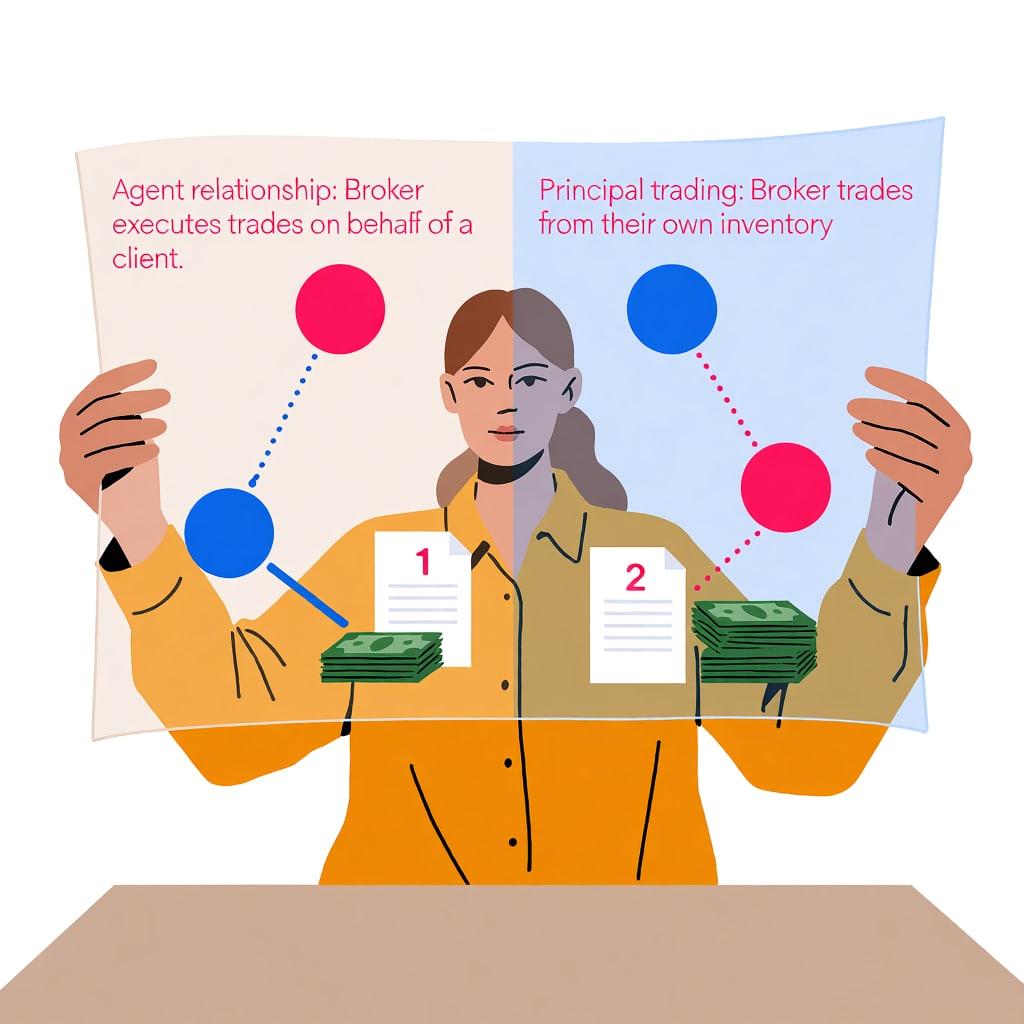
Retail traders often conflate "broker" with "broker-dealer," using the terms interchangeably to describe any trading platform. The distinction matters. A broker acts as an agent executing trades on your behalf; a dealer trades for its own account. A broker-dealer firm does both. This legal and operational difference shapes regulatory requirements, potential conflicts of interest, and the protections available to you. Understanding which entity type you're working with, and what services it actually offers, is essential when choosing where to trade stocks, options, forex, or other securities.
This guide clarifies the structures, regulatory frameworks, and decision factors that apply across different client classes. It explains what to verify before opening an account and highlights the trade-offs between cost, features, and investor protection. The research reflects regulatory frameworks as of 12 November 2026.
Eligible accounts at a glance
A broker-dealer operates under a dual legal role that determines which account types it can service and what protections apply.
Broker-dealers register with financial authorities in their jurisdiction, the Securities and Exchange Commission (SEC) and Financial Industry Regulatory Authority (FINRA) in the United States, the Financial Conduct Authority (FCA) in the UK, and equivalent bodies elsewhere. This registration carries specific capital adequacy requirements, compliance obligations for anti-money laundering and customer protection, and, in the US, often membership in the Securities Investor Protection Corporation (SIPC).
SIPC protects customer securities and cash up to $500,000 per account, with a limit of $250,000 on cash claims. Other jurisdictions offer equivalent investor compensation schemes, though the structure and limits vary.
Account types typically available through broker-dealers include individual trading accounts, joint accounts, retirement accounts (IRAs, 401(k)s in the US; equivalent structures internationally), custodial accounts, and high net worth or institutional accounts. Retail investors, institutional investors (pension funds, mutual funds, hedge funds), and high net worth individuals may all hold accounts at the same firm, though regulatory treatment and available services can differ by client class.
Selection criteria and date
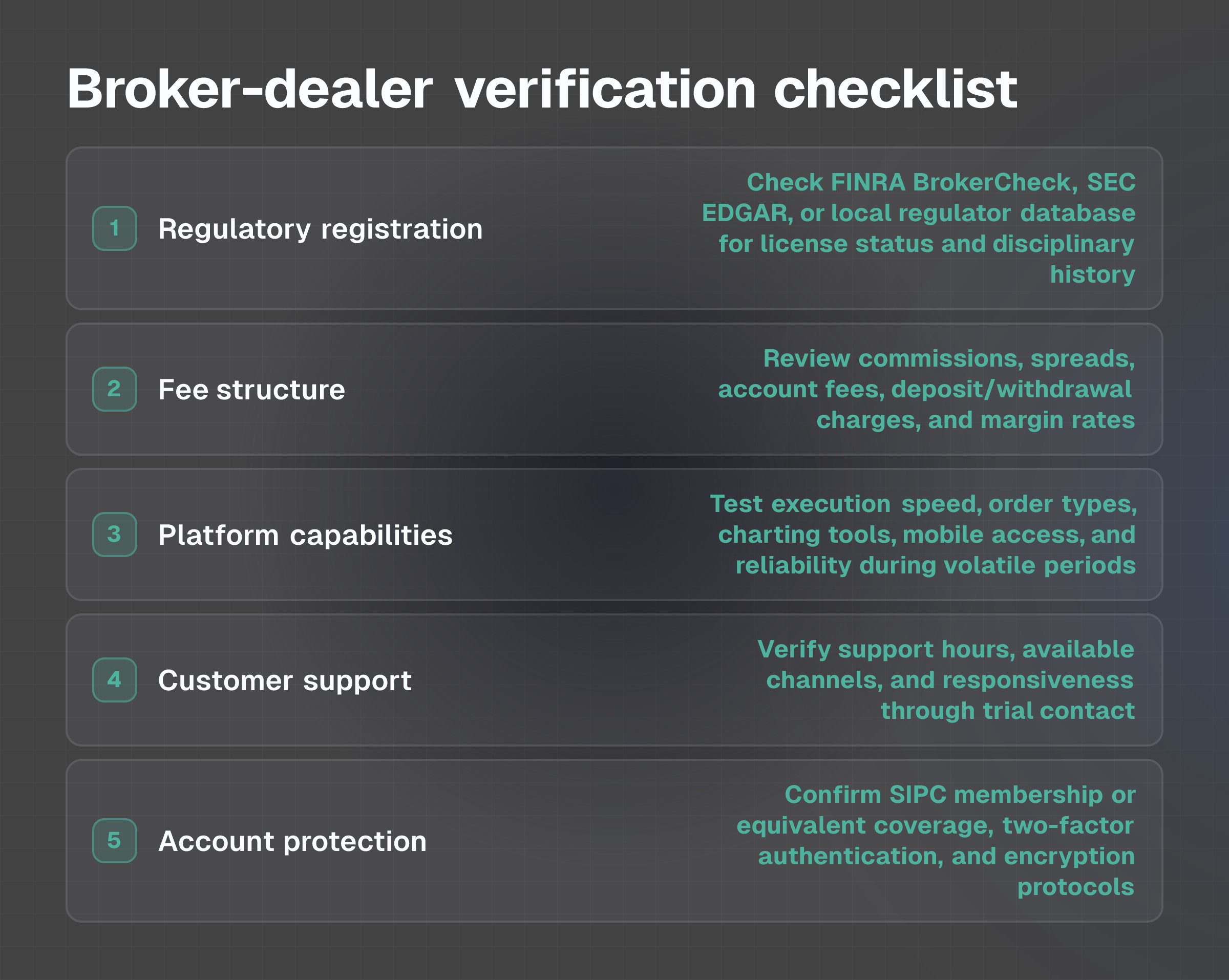
Choosing a broker-dealer requires evaluating regulatory compliance, fee structures, platform capabilities, customer support, and account protection measures.
This comparison focuses on registered broker-dealers serving retail traders in single-asset or multi-asset trading.
Last verified: November 12, 2026
Regulatory verification and licensing
Confirm that the firm is registered with the appropriate regulator in your jurisdiction. For US firms, check the FINRA BrokerCheck database and SEC EDGAR for registration status and any disciplinary history. For international firms, use your local regulator's register. Don't assume a firm is legitimate without confirmation of its registration number and current license status.
Fee structure assessment
Understand all charges before opening an account.
Commissions: Per-trade fees, share-based pricing, or commission-free models. Note that "commission-free" often means the firm generates revenue through payment for order flow or wider spreads rather than direct fees.
Spreads: The difference between bid and ask prices, relevant for forex and other instruments where the broker-dealer acts as a dealer providing liquidity.
Account maintenance: Inactivity fees, annual fees, or minimum balance requirements.
Deposit and withdrawal charges: Fees for moving funds in or out.
Other costs: Margin interest rates, data fees, statement fees.
Platform and execution quality
Assess the trading platform for order execution speed, reliability, available order types, charting tools, technical indicators, and mobile accessibility. Research and education resources (analyst reports, market data, tutorials) vary significantly between firms.
Customer support and resources
Verify the availability of support (hours, channels: phone, email, live chat) and responsiveness. FAQs and help sections reflect the depth of self-service resources available.
Security and account protection
Verify SIPC membership (US) or equivalent investor compensation coverage (other jurisdictions). Review cybersecurity measures: two-factor authentication, encryption, data storage protocols.
Understand the limits of protection. Neither regulatory registration nor insurance covers trading losses or market risk.
Account comparisons and limitations
The research available doesn't include measured spread data, published execution statistics, or specific account features from individual broker-dealers that would allow a ranked comparison. This article therefore doesn't compare accounts by cost or performance.
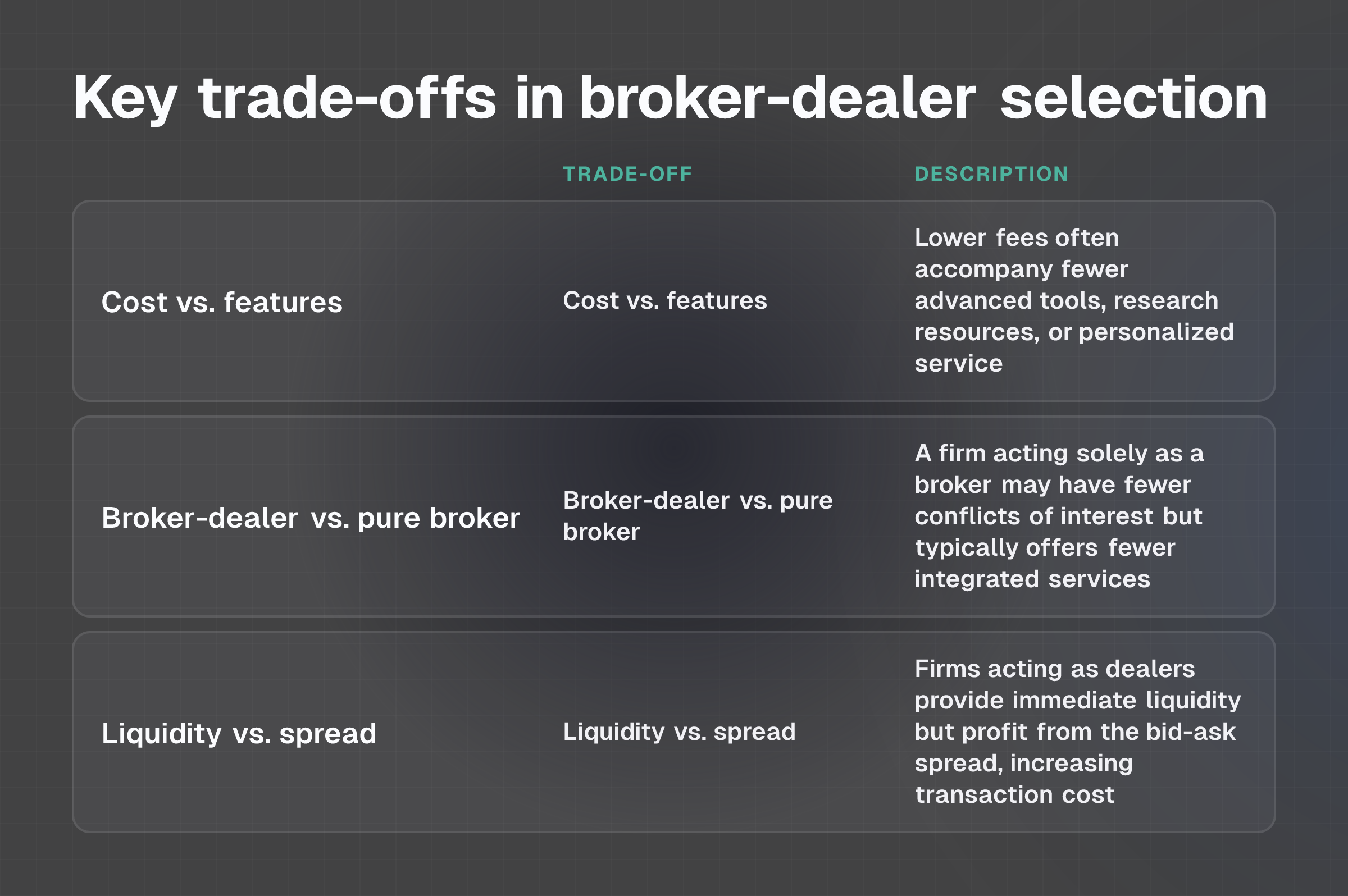
Key trade-offs in choosing a broker-dealer structure:
| Trade-off | Description |
|---|---|
| Cost vs. features | Lower fees often accompany fewer advanced tools, research resources, or personalized service. |
| Broker-dealer vs. pure broker | A firm acting solely as a broker may have fewer conflicts of interest but typically offers fewer integrated services (e.g., no underwriting, market making, or dealer inventory). |
| Liquidity vs. spread | Firms acting as dealers provide immediate liquidity by trading from their own account, but profit from the bid-ask spread, which increases your transaction cost. |
Conflict of interest risk
Broker-dealers face an inherent conflict: they act as agents for clients while also trading for their own profit.
Regulators impose rules, such as FINRA Rule 5310 on best execution, to require firms to seek the most favorable terms available for client trades rather than prioritizing the firm's own gains. This rule doesn't eliminate the conflict; it manages it. Retail traders should understand that a firm acting as both broker and dealer has a structural incentive to widen spreads or prioritize its own positions.
Regulatory gaps across jurisdictions
Capital adequacy requirements for broker-dealers vary significantly by jurisdiction and by the type of activity (equities, derivatives, forex, etc.). The US, UK, Australia, and other regulated markets set different thresholds.
This article doesn't cover jurisdiction-specific capital rules. Consult your local regulator's documentation or a compliance specialist if capital stability is a key concern.
Common mistakes
Not verifying registration: Assuming a firm is legitimate without checking its regulator's database.
Ignoring the fee schedule: Hidden charges or payment-for-order-flow models can erode returns over time.
Choosing by marketing alone: Failing to assess platform reliability, security, and customer service quality.
Misunderstanding "commission-free" models: Not realizing how firms offset zero commissions through order flow payments or wider spreads.
Not reading terms and conditions: Margin account rules, leverage caps, and restrictions on complex products are often in the fine print.
Which conditions fit each need
Different trading goals and risk profiles align with different evaluation priorities.
Day traders and frequent traders
Best for: Traders executing multiple trades per session, sensitive to execution speed and order fill quality.
Main concerns: Platform uptime and reliability, order execution latency, available order types (stop-loss, limit, trailing stops), and total transaction costs (commissions + spreads).
Evaluation focus:
- Confirm the firm publishes order execution statistics or offers a trial period to test fill quality.
- Verify platform stability during volatile markets.
- Calculate total cost-per-trade including commissions and typical spreads.
Swing traders and intermediate-term investors
Best for: Traders holding positions for days to weeks, with moderate trading frequency.
Main concerns: Competitive spreads and commissions, availability of technical analysis tools, and reliable customer support when issues arise.
Evaluation focus:
- Compare published fee schedules across multiple firms for your preferred instruments.
- Test the platform's charting and alert features.
- Confirm phone or live chat support availability during your trading hours.
Long-term investors and buy-and-hold accounts
Best for: Investors building positions over months or years, with lower trading frequency.
Main concerns: Account safety (regulatory registration, SIPC or equivalent coverage), ease of deposits and withdrawals, research quality, and low account maintenance fees.
Evaluation focus:
- Verify SIPC membership and understand the $500,000 protection limit.
- Check for inactivity fees or minimum balance requirements.
- Evaluate the quality and depth of research (analyst reports, market commentary).
- Confirm withdrawal processing times and any associated fees.
Retail traders trading multiple asset classes
Best for: Traders moving between stocks, options, ETFs, forex, or futures on a single platform.
Main concerns: Platform integration, availability of all desired asset classes, competitive pricing across instruments, and regulatory compliance for each asset type.
Evaluation focus:
- Confirm the firm is registered to offer each instrument you intend to trade (some brokers focus on equities only; others offer forex or derivatives).
- Test the platform's ability to move between asset classes seamlessly.
- Compare fees for each asset class, as commissions and spreads often differ.
Institutional and high net worth accounts
Best for: Larger organizations or individuals with substantial capital, requiring dedicated support and custom solutions.
Main concerns: Dedicated account management, customized fee structures, advanced platforms, and access to institutional research.
Evaluation focus:
- Contact the firm's institutional sales team to negotiate terms specific to your account size.
- Verify that institutional clients receive the same regulatory protections as retail clients (SIPC or equivalent).
- Confirm API access or integration capabilities if required.
For a detailed comparison of how broker and dealer roles differ in practice, see Is Your Forex Broker the Counterparty? How to Check. To understand how these regulatory structures affect costs, read Forex Trading Costs Explained: Compare More Than the Spread. For an overview of how broker-dealers compete across platforms, explore MT4 and MT5 Brokers: Compare Account and Platform Access.